Leaf Peeping Near Deerfield Beach, FL
Leaf peeping near Deerfield Beach means cypress more than maples. The closest color is at Fern Forest Nature Center in Coconut Creek, about ten minutes west, where pond cypress and red maples, the site's two deciduous trees, turn along a free boardwalk in mid-to-late November. The place in Florida that best delivers a true hardwood display is Torreya State Park, where sugar maple and sweetgum start turning in late October, and it is roughly 466 miles from Palm Beach County.
Everything else on the list trades distance for drama. Six cypress swamps sit within a day's drive, from Fern Forest out to Audubon Corkscrew Swamp Sanctuary near Naples, and all of them show their color from a boardwalk: bronze needles over still water. The Panhandle parks have maples, beech, oaks and sweetgum, but they are a weekend away, not an afternoon.
Our picks
- Closest to home: Fern Forest Nature Center. Free, about ten minutes west in Coconut Creek, with a boardwalk over pond cypress and red maples.
- Best cypress trip from South Florida: Audubon Corkscrew Swamp Sanctuary. More than two miles of boardwalk into the largest old-growth bald cypress forest left, with trees over 500 years old.
- Ancient cypress for a few dollars: Fakahatchee Strand Preserve State Park. $3 per car for a raised boardwalk under ancient cypress off US 41, close enough to string together with Big Cypress in one day.
- Real hardwood color: Torreya State Park. Southern sugar maple, sweetgum and sourwood on steep bluffs above the Apalachicola River, turning from late October.
- Color from the car: Ormond Scenic Loop and Trail. A free 30-mile double loop north of Daytona past red maples, pignut hickory and oaks, which you can join at several points.
At a glance
| Option | Entrance Fee | Address | Fall Color Trees | Peak Color | How to See It | Managed By |
|---|---|---|---|---|---|---|
| Freesource | 201 Lyons Rd S, Coconut Creek, FLsource | Cypress and hardwoodssource | Mid-to-late Novembersource | Boardwalksource | County parksource | |
| $10source | 10216 Lee Road, Boynton Beach, FL 33473source | Bald cypresssource | Mid-to-late Novembersource | Boardwalksource | National wildlife refugesource | |
| Freesource | 52105 Tamiami Trail East, Ochopee, FL 34141source | Bald cypresssource | Mid-to-late Novembersource | Boardwalksource | National preservesource | |
| $3source | 137 Coastline Dr, Copeland, FLsource | Bald cypresssource | Mid-to-late Novembersource | Boardwalksource | Florida state parksource | |
| $17source | 375 Sanctuary Road West, Naples, FL 34120source | Bald cypresssource | Mid-to-late Novembersource | Boardwalksource | Audubon sanctuarysource | |
| $5source | 7751 Penzance Blvd, Fort Myers, FL 33966source | Bald cypresssource | Mid-to-late Novembersource | Boardwalksource | County parksource | |
| $6source | 5931 Hammock Rd, Sebring, FLsource | Cypress and hardwoodssource | Mid-to-late Novembersource | Boardwalksource | Florida state parksource | |
| Freesource | 11080 East Moccasin Slough Road, Inverness, FLsource | Cypress and hardwoodssource | Late Octobersource | Hiking trailssource | Water management districtsource | |
| $6source | 100 Savannah Blvd, Micanopy, FLsource | Marsh grassessource | Hiking trailssource | Florida state parksource | ||
| Freesource | Ormond Beach, FLsource | Maple, hickory and oaksource | Mid-to-late Novembersource | Scenic drivesource | ||
| $6source | 465 Wakulla Park Drive, Wakulla Springs, FLsource | Sugar maple and beechsource | Mid-to-late Novembersource | Boat toursource | Florida state parksource | |
| $3source | 2576 NW Torreya Park Rd, Bristol, FLsource | Sugar maple and sweetgumsource | Late Octobersource | Bluff trailssource | Florida state parksource | |
| $3source | 7908 Three Rivers Park Rd, Sneads, FL 32460source | Oak, maple and pinesource | Mid-to-late Novembersource | Hiking trailssource | Florida state parksource | |
| $5source | 1130 State Park Rd, Chipley, FLsource | Mid-to-late Novembersource | Hiking trailssource | Florida state parksource |


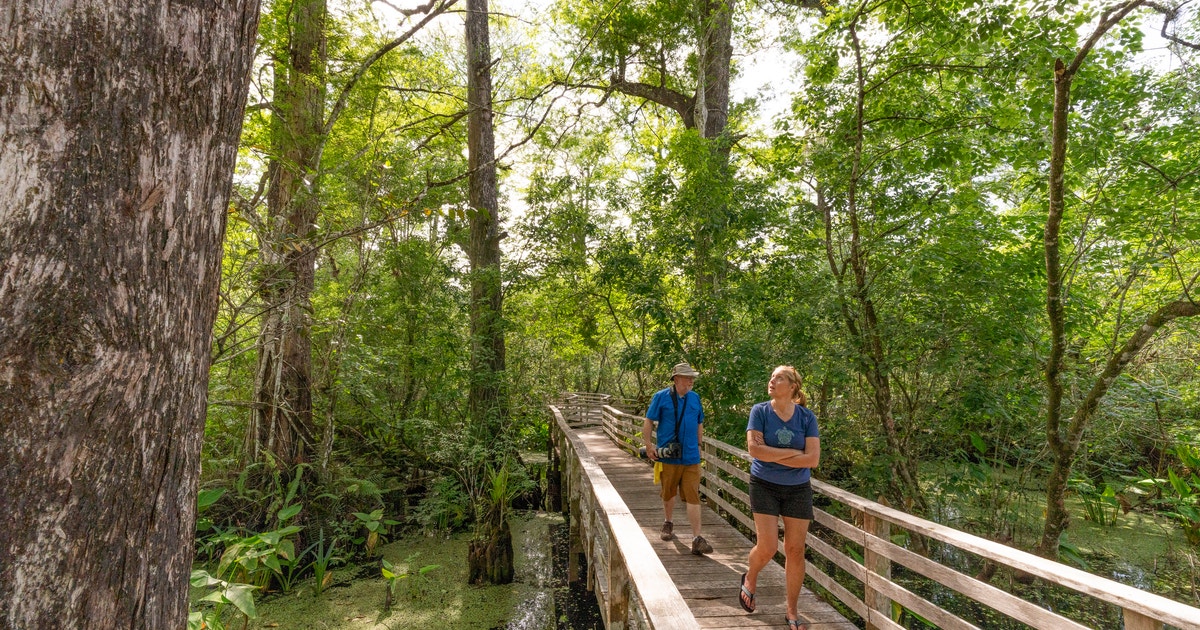


What turns color in a South Florida swamp
Cypress drop their needles, and before they do the needles go rust, copper and bronze. That is most of the show on the day-trip half of this list. Arthur R. Marshall Loxahatchee National Wildlife Refuge, about half an hour up the road, has a short accessible boardwalk through cypress swamp for $10 a carload. Big Cypress National Preserve, two hours west across Alligator Alley, is free and has the most cypress country to drive through, though the color is subtle enough that first-timers can miss it.
Corkscrew is the showpiece, but its $17 is charged per person, not per car, so a family of four pays far more than the column suggests. Six Mile Cypress Slough Preserve's $5 is a daily cap on hourly parking, and its trees are mostly second growth, smaller than Corkscrew's. Corkscrew also keeps shorter hours than a state park, so check before the drive to Naples.
A day trip, a weekend, or the Panhandle
Highlands Hammock State Park near Sebring, about two and a half hours north, is the farthest you can reasonably go and come back the same day, and its CCC-era Cypress Boardwalk mixes turning cypress with hardwood understory. Central Florida adds variety rather than a canopy display: Paynes Prairie Preserve State Park turns golden bronze with marsh grass rather than leaves, and Flying Eagle Preserve near Inverness has about 22 miles of dirt trail through hardwood and cypress.
The Panhandle is where the leaves are. Three Rivers State Park on Lake Seminole and Falling Waters State Park each sit about an hour from Torreya, so the three work as one loop, and Edward Ball Wakulla Springs State Park, south of Tallahassee, shows its maples and beech from a riverboat tour. Torreya has the strongest color, and at Falling Waters it is thinner, with mostly longleaf pine on its ridges and a waterfall of about 73 feet as the real draw.
Late October or late November
Eleven of the fourteen rows peak in mid-to-late November, because Florida's foliage sources give timing by species and region rather than park by park. Two go earlier: Torreya and Flying Eagle both start turning in late October, which makes Flying Eagle the southernmost place here to catch the season's opening. Paynes Prairie has no stated peak for its grasses.
The options in detail
Fern Forest Nature Center
The closest thing to leaf peeping you can reach from Deerfield Beach without leaving Broward County: a 244-acre preserve about ten minutes west, where an elevated boardwalk crosses a remnant of the Cypress Creek floodplain. Pond cypress and red maples are the two deciduous trees here, so late in the year you get rust and copper needles over dark water rather than a hillside of color. It is free, flat and short, which makes it an easy after-work walk rather than a day out. Set expectations accordingly: this is a quiet urban swamp, not a foliage destination.
Arthur R. Marshall Loxahatchee National Wildlife Refuge
A half-hour up the road from Deerfield Beach, this refuge protects the northernmost remnant of the Everglades, and the short Cypress Swamp Boardwalk behind the visitor center is the reason to come in the fall. The loop runs through a genuine cypress swamp, so when the needles turn you get bronze reflected in still water, usually with alligators and wading birds thrown in. The walk is a fraction of a mile and fully accessible, so it pairs well with the longer levee trails if you want to make a morning of it. The refuge charges by the carload, and the boardwalk is the only stretch that really reads as autumn.
Big Cypress National Preserve
About two hours west across Alligator Alley, Big Cypress is the largest stand of cypress country you can drive to from South Florida, and in late fall the cypress domes scattered through the wet prairie go rust and copper. The Oasis Visitor Center has a short boardwalk over a canal that is usually lined with alligators, and the Loop Road and Turner River Road give you miles of slow driving through the same scenery. Entry is free, which makes it the cheapest real fall outing on this list. The trade-off is distance and mosquitoes, and the color is subtle enough that first-timers sometimes drive through it without noticing.
Fakahatchee Strand Preserve State Park
Florida's largest state preserve sits just west of Big Cypress and protects the deepest cypress strand in the state, the one orchid hunters made famous. The Big Cypress Bend Boardwalk off US 41 is the easy way in: a short raised walk under genuinely ancient trees, ending at a viewing platform over a gator pond. For three dollars a car it is the best value on this list, and it is close enough to Corkscrew and Big Cypress to string all three into one day. Most of the preserve's 85,000 acres are trackless swamp, so the boardwalk and the Janes Scenic Drive are realistically all a casual visitor will see.
Audubon Corkscrew Swamp Sanctuary
If you only make one cypress trip from South Florida, this is the one worth the drive. Corkscrew protects the largest surviving old-growth bald cypress forest anywhere, with trees over 500 years old, and the whole thing is reachable on a boardwalk that runs more than two miles through marsh, pine flatwoods and finally the deep shade of the ancient stand. When the needles turn, the canopy overhead goes copper and the light on the water is the closest Florida gets to a New England postcard. It is the most expensive stop here by a wide margin, and the sanctuary keeps shorter hours than a state park, so check before you drive out.
Six Mile Cypress Slough Preserve
A wetland corridor running through suburban Fort Myers, with a wide accessible boardwalk that loops through a dark cypress strand and past two ponds. It is the easiest cypress walk on this list to combine with an actual errand, since it sits minutes off I-75, and the pay-by-the-hour parking means a quick look costs almost nothing. Loggers cleared this county in the 1930s, so most of the trees are second growth and smaller than Corkscrew's, though a few gnarled old pond cypress survived. Good for a stretch of the legs on the way to or from Naples rather than a destination in its own right.
Highlands Hammock State Park
One of Florida's original state parks, about two and a half hours north of Deerfield Beach, protecting an old-growth oak and palm hammock with trees centuries old. The draw in the fall is the Cypress Boardwalk, a CCC-era catwalk with a rail on only one side that takes you out over a swamp basin, plus a loop road with short trails peeling off it that you can walk or bike. This is the northernmost stop still reachable as a long day trip from Broward County. The colour is a mix of turning cypress and hardwood understory rather than a canopy display, so treat it as a good hike with autumn touches.
Flying Eagle Preserve
Nearly 11,000 acres of hardwood, marsh and lake country in the Withlacoochee basin near Inverness, laced with about 22 miles of multi-use trail. It matters on this list because it is the southernmost site where sources say the hardwoods and cypress start turning in late October rather than waiting for the end of November, so it opens the season for anyone driving up from the coast. It is free and it is a stop on the Great Florida Birding and Wildlife Trail, which makes it a good pairing with a Crystal River or Ocala weekend. There is no boardwalk and no visitor centre: you are hiking or biking dirt trails, and a reservation is needed if you want to camp.
Paynes Prairie Preserve State Park
A 22,000-acre grassland basin between Micanopy and Gainesville where the autumn show comes from the prairie itself rather than from trees: the marsh grasses turn a golden bronze across an opening wide enough to see weather coming. Bison and wild horses roam free here, and the trail network includes the La Chua Trail and the long Gainesville-Hawthorne rail trail. It is a genuinely different kind of fall scenery, and worth the stop if you are already driving north. If you specifically want turning leaves, this is the wrong park: there is no canopy display, and the basin floods in some seasons.
Ormond Scenic Loop and Trail
The only drive-it option here: a 30-mile double loop north of Daytona that strings together four state parks and six local parks along creeks, marshes, beach and the Halifax River. Red maples, pignut hickory and oaks give it the most varied colour of anything within a half-day of South Florida, and because it is a public road network it costs nothing and you can join it at several points. Cyclists use it heavily, so it doubles as a ride. It is a route rather than a destination, which means no single trailhead, no gate and no ranger to ask about conditions.
Edward Ball Wakulla Springs State Park
South of Tallahassee, built around one of the world's largest and deepest freshwater springs, with a 1930s lodge and cypress swamp along the river. The fall draw is red sugar maples and the tan leaves of beech, plus beautyberry turning purple once the weather cools, and the classic way to see it is the narrated riverboat tour rather than a trail. The setting is photogenic enough that Hollywood used it for Creature from the Black Lagoon and a Tarzan picture. It is a long haul from Deerfield Beach at roughly 400 miles, so it belongs in a Panhandle trip rather than a day out.
Torreya State Park
This is the one place in Florida that genuinely delivers what a leaf peeper is picturing. Perched on steep bluffs above the Apalachicola River at the southernmost tip of the Appalachian range, it has the elevation and the species mix (southern sugar maple, sweetgum, sourwood) to put on a real display, and it starts turning in late October, earlier than the rest of the state. The Weeping Ridge and Rock Creek trails drop through ravines and bottomland that look nothing like the rest of Florida. The catch is distance: it is roughly 466 miles from Palm Beach County, an eight-hour-plus drive each way, so it is a trip, not an outing.
Three Rivers State Park
On the Georgia line where the Chattahoochee and Flint meet to form Lake Seminole, this small Panhandle park has slopes steep enough to create a microclimate, which is why trillium and trout lily grow in its hardwood forest. In autumn the hiking is about brilliantly coloured oaks and maples with deep-red pine mixed in, and sassafras turning along the trails. Three short loops (Lakeview, Dry Creek, Eagle) cover the park, and the fishing on Lake Seminole is a draw in its own right. Like the other Panhandle stops it is roughly 470 miles from South Florida, and it is quieter and less dramatic than Torreya an hour away.
Falling Waters State Park
Best known for Florida's tallest waterfall, which drops about 73 feet from a limestone lip straight into a deep cylindrical sinkhole, reached by trails and a boardwalk overlook. The autumn colour here is a bonus rather than the headline: sources note brightly coloured leaves in season, but the ridges are mostly longleaf pine and wiregrass, so it is thinner than Torreya an hour east. What it does have is genuinely unusual terrain, rolling hills and a cave at the bottom of the sinkhole. Worth folding into a Panhandle loop with Torreya and Three Rivers rather than driving 500 miles for on its own.
How we researched this
The list runs from Coconut Creek to Chipley and stops at the state line on purpose. North Georgia and the Blue Ridge are a flight or a ten-hour drive, and mixing them in would put a week's vacation beside an after-work walk. The Panhandle is the honest far end of a drivable list. Blackwater River State Forest, even farther out near Alabama, was cut because the only evidence of color there was a passing phrase, and Riverbend Park in Jupiter and Wekiwa Springs because nothing quotable described their fall color.
Fees, addresses and land managers for many rows come from floridahikes.com, an independent trail guide, because the official state park pages would not load for us; the timing comes from Florida fall-color reporting that names species and months. Three cells are empty where no source states the fact: Paynes Prairie's peak, the species behind Falling Waters' colorful leaves, and a managing body for the Ormond loop, which is a public road network with no single owner. The Ormond pin marks the town, since the loop has no single trailhead. Peak Color is a regional window rather than a forecast for any one park, so it is worth calling ahead before the long drives.