Mountain Biking Trails Near Beaumont With RV Hookups
For riding, Double Lake Recreation Area near Coldspring is the answer: a twenty-one mile mountain bike trail loops the lake, with the campground on site, at $30 a night with an electric hookup. Huntsville State Park has the same 21 miles of trail and much better RV facilities, with full hookups and pull-through sites from $25 a night.
Closer to home, Village Creek State Park sits about ten miles north of Beaumont at $16 a night, but its 8 miles of trail are flat, sandy and short. That is the trade across all nine parks, which run from 12 to 120 miles out: the parks with serious trail mileage are an hour or more away, and the best-equipped RV campgrounds are not always where the best riding is.
Our picks
- Riding first, hookups second: Double Lake Recreation Area. A 21-mile mountain bike trail loops the lake with the campground on site; sites have electric only and book through Recreation.gov.
- A long motorhome and a full day of trail: Huntsville State Park. Full-hookup pull-through sites with drive lengths from 38 to 80 feet, and 21 miles of trail at Lake Raven.
- A quick overnight close to town: Village Creek State Park. About ten miles north of Beaumont at $16 a night, with 8 miles of flat bottomland trail through cypress swamp and pine.
- Easy miles for relaxed riders: Brazos Bend State Park. 37 miles of trail, much of it wide, flat or paved, around a chain of lakes, with water and electric sites at $25.
At a glance
| Option | RV Site Rate | Address | Hookups | Bike Trail Miles | Managed By | Water Access |
|---|---|---|---|---|---|---|
| $16source | 8854 Park Road 74, Lumberton, TX 77657source | Water and electricitysource | 8source | Texas state parksource | Creeksource | |
| $16source | 634 Park Road 48 South, Jasper, TX 75951source | Water and electricitysource | Texas state parksource | Lakesource | ||
| $18source | 300 Park Road 65, Livingston, TX 77351source | Full hookupssource | Texas state parksource | Lakesource | ||
| $27source | 25840 FM 1485, New Caney, TX 77357source | Water and electricitysource | 20source | City parksource | Creeksource | |
| $30source | 301 FM 2025 Rd, Coldspring, TX 77331source | Electric onlysource | 21source | National forestsource | Lakesource | |
| $25source | 565 Park Road 40 W, Huntsville, TX 77340source | Full hookupssource | 21source | Texas state parksource | Lakesource | |
| $20source | 14901 FM 3005, Galveston, TX 77554source | Water and electricitysource | 4source | Texas state parksource | Beachsource | |
| $25source | 21901 FM 762, Needville, TX 77461source | Water and electricitysource | 37source | Texas state parksource | Lakesource | |
| $30source | Park Road 38, San Felipe, TX 77473source | Full hookupssource | 5source | Texas state parksource | Riversource |


How many miles of trail each park has for bikes
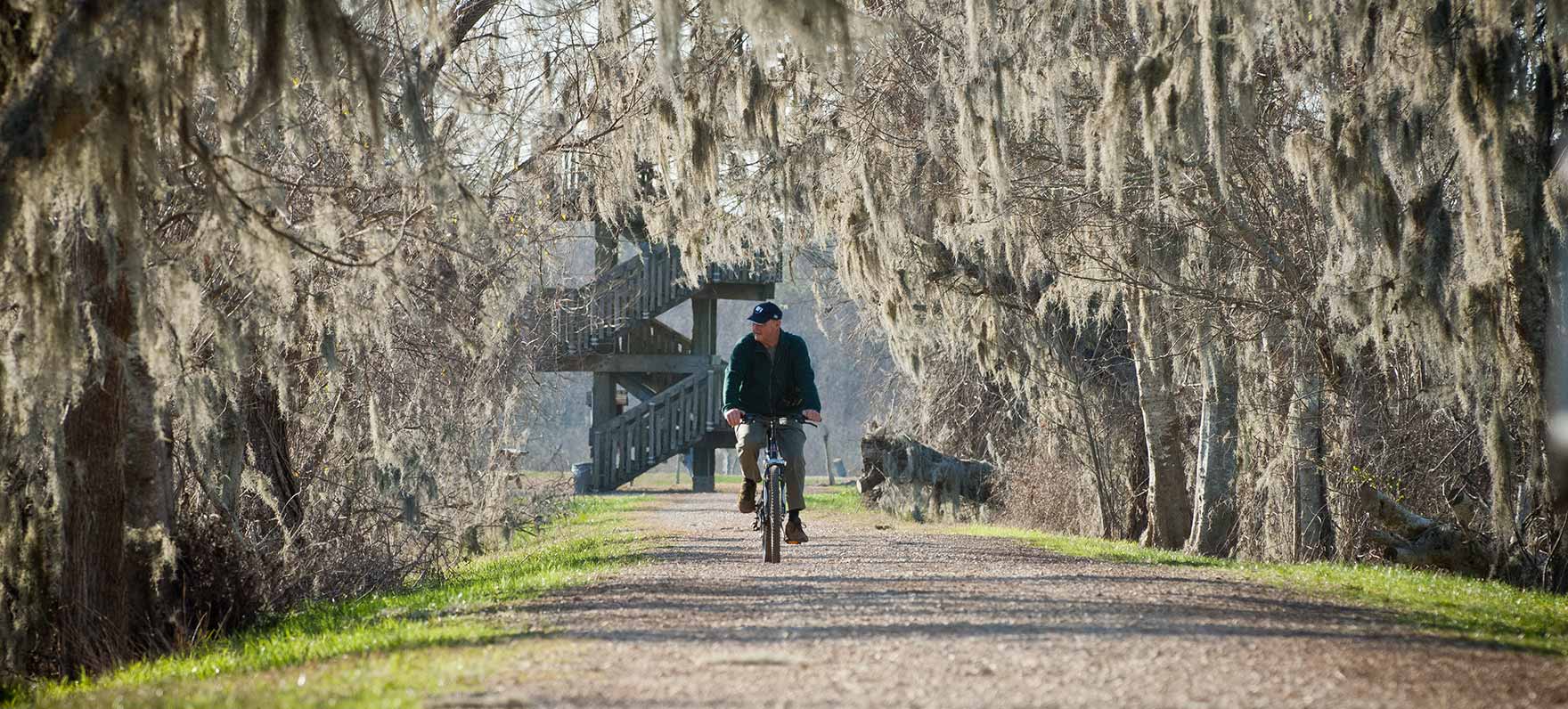
Brazos Bend has the most at 37 miles, shared with horses and walkers and suited to a cruiser more than a technical rider. Double Lake and Huntsville have 21 each, and Lake Houston Wilderness Park has more than 20, though the park warns that sand deposits make fat tires the better choice. Below that the riding drops off fast: 8 miles at Village Creek, 5 at Stephen F. Austin, and 4 exposed, windy miles at Galveston Island.
Martin Dies, Jr. and Lake Livingston allow bikes but publish no total mileage. Both have short trails, and Martin Dies earns a mention for its Island Trail, whose curves and hills are the closest thing to technical riding within an hour of Beaumont.
Full hookups, water and electric, or electric only
Three parks have full hookups: Lake Livingston, Huntsville and Stephen F. Austin, at $18, $25 and $30 for their cheapest RV site. Stephen F. Austin's full-hookup loop bans generators, which keeps it quiet. Five offer water and electricity, including Lake Houston, whose twelve RV sites fill quickly. Double Lake is the only one with electric alone, the thinnest hookups here on the park with the best trail.
Weekends need planning at the popular parks. Most of Lake Livingston's loops, and Huntsville on Friday and Saturday nights, carry a two-night minimum. The listed rate is each park's cheapest hookup site, which is not always the site with the best hookups, so a full-hookup pad can cost more than the figure in the table.
State park, national forest or city park
Seven of the nine are Texas state parks, where a Texas State Park Pass covers entry. The other two work differently. Double Lake is a Forest Service site on Recreation.gov with day use charged per vehicle, and Lake Houston Wilderness Park is run by the City of Houston, with entry charged per person on top of the site fee, which adds up for a full rig.
The options in detail
Village Creek State Park
The closest option to Beaumont by a wide margin, about ten miles north of town on the edge of the Big Thicket. Eight miles of sandy bottomland trail wind through cypress swamp and upland pine, and the same paths are open to bikes and to walkers. The campground is small and the nightly rate is the lowest in this set, which makes it an easy overnight rather than a destination. The riding is flat and short, so anyone looking for a full day in the saddle will run out of trail.
Martin Dies, Jr. State Park
Two rivers meet at B.A. Steinhagen Reservoir here, and the park spreads across units on either side of the water with over 200 campsites, most of them water and electric. The trails are multiuse and mostly short loops, though the Island Trail's curves and hills are the closest thing to technical riding within an hour of Beaumont. Paddling is the bigger draw, with nearly fourteen miles of marked water trails through the sloughs. The park publishes no total bike mileage and its named trails each run under a mile, so the riding is an add-on rather than the reason to come.
Lake Livingston State Park
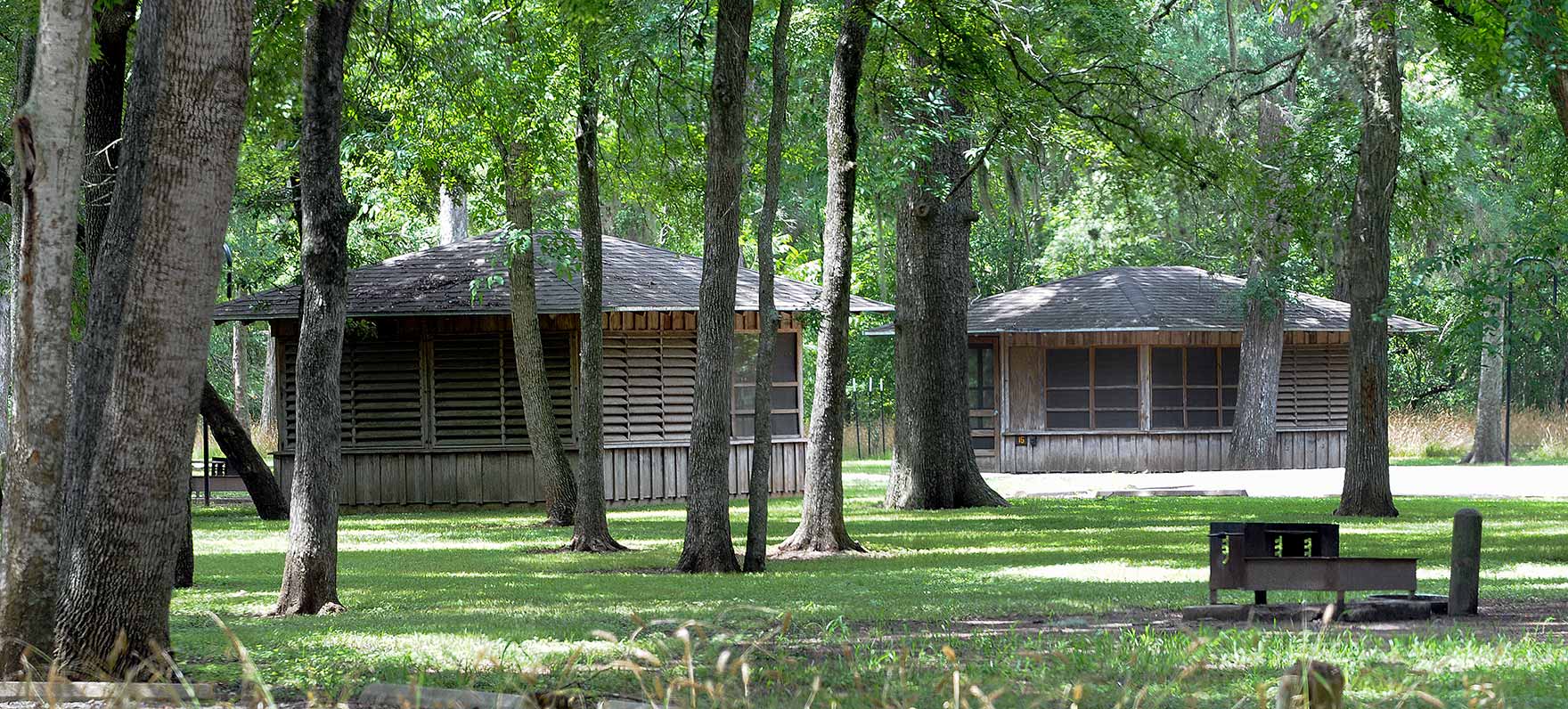
A lakeside pineywoods park where every trail allows biking unless posted otherwise, and where the campground is unusually well set up for RVs: four separate full-hookup loops, plus cheaper water-and-electric sites for anyone who does not need sewer. Most loops require a two-night minimum over a weekend. The trail network is modest, a set of short connectors linking the camping areas to the boardwalk and the shoreline, so this works as a comfortable basecamp with easy riding rather than a trail destination.
Lake Houston Wilderness Park
Nearly 5,000 acres of forest three miles east of New Caney, and the only park in the Houston system that allows overnight stays. More than twenty miles of trail are open to bikes, though the park is candid that many of them carry sand deposits and that fat tires work better than thin ones. There are only twelve RV sites, all with water and electricity and a few with sewer, so the loop is small and fills up. Entry is charged per person on top of the site fee, which adds up for a full rig.
Double Lake Recreation Area
The strongest riding within two hours of Beaumont: a twenty-one mile mountain bike trail loops the lake, and the recreation area itself is a Civilian Conservation Corps site from 1937 built around a small lake stocked with bass, bream and catfish. Camping is run by the Forest Service and booked through Recreation.gov, and the RV sites carry an electric hookup but no sewer. Swimming, fishing and a five-mile stretch of the Lone Star Hiking Trail are all on site. Day use is charged per vehicle rather than per person, and the hookups are the thinnest of any park here.
Huntsville State Park
Set inside the Sam Houston National Forest around 210-acre Lake Raven, with twenty-one miles of trail and a long-standing following among Houston-area riders. The full-hookup loop is explicitly designed for motorhomes, with pull-through sites and drive lengths from 38 to 80 feet, which makes it the easiest park in this set to get a large rig into. Cheaper water-and-electric sites sit in the Coloneh and Prairie Branch areas. It is popular enough that Friday and Saturday nights carry a two-night minimum, and alligators live in the lake.
Galveston Island State Park
A coastal park rather than a woods park, with four miles of flat trail crossing dune, marsh and coastal prairie on the bay side of the island. Camping splits between beachside sites, which cost more and sit out in the open, and bay-side sites that are cheaper but packed close together around a shared pavilion. The riding is short and exposed with no shade and steady wind. This is a stop for someone who wants the beach with a little riding attached rather than the other way around.
Brazos Bend State Park
Thirty-seven miles of trail, the largest network in this set, circling a chain of lakes and running out into hardwood forest, open to bikes and horses as well as walkers. Much of it is wide and flat and part of it is paved, which suits a cruiser better than a technical rider. Alligators are common here and the park posts safety guidance about them on its maps and signs. Campsites are water and electric with no sewer loop, and it is one of the longest drives from Beaumont.
Stephen F. Austin State Park
A quiet park on the banks of the Brazos River with five miles of hiking and biking trail running through river-bottom hardwoods and upland swamp. The full-hookup loop is pull-through and reserved for RVs and pop-up campers, with generators not allowed, which keeps it unusually quiet for a hookup loop. Five miles is not much riding, and at the far edge of a day trip from Beaumont it earns its place mainly on the strength of the campsites rather than the trails.
How we researched this
Each park had to pass two tests on its own agency's pages: bikes allowed on its trails, and campsites with at least an electric hookup. Cagle Recreation Area has 47 full-service sites but lists no biking, Fort Boggy has 3.5 miles of bike trail but only hike-in primitive camping, and Mission Tejas and Sea Rim never say bikes are allowed, so all four are out. Ratcliff Lake's Forest Service page was down, so its biking could not be confirmed. Private RV parks advertising bike trails mean paved loops inside the park and were not counted. The list stays in Texas, which leaves out Louisiana's Sam Houston Jones State Park, closer to Beaumont than half the parks here.
Nightly rates are before the entrance fee. Double Lake is listed as electric only because the Forest Service fee schedule mentions no other hookup, though some campground sites claim water as well. Trail mileage is each agency's own figure, and the two empty mileage cells are parks that publish none. The far end of the list, Stephen F. Austin at about 120 miles, stretches the word near, so check each address against your own drive.