Best Ecommerce Platforms for Law Firms
For a law firm that wants to keep the website it already has, WooCommerce and Ecwid by Lightspeed are the answer: they are the only two of these 15 platforms whose setup adds a store to an existing site, rather than building a new one or hosting the store elsewhere. WooCommerce is free and open source and takes no cut of sales, but it needs a WordPress site; Ecwid charges no setup or transaction fees of its own and drops into a site built on almost anything.
Past that, the choice turns on how each platform gets paid. Payhip, Gumroad and the entry plans of Squarespace, Podia and Teachable take a percentage of every sale, from 2% on a Squarespace Basic store order to 10% + $0.50 on a Gumroad sale through the firm's own link, which costs little while sales are occasional and stings on a flat-fee package. Sellfy, Kajabi, SamCart and BigCommerce charge a monthly fee and take no cut of their own (SamCart and BigCommerce only when sales run through their own payment options), the better shape for a firm selling a few expensive things.
Our picks
- Firm site already on WordPress: WooCommerce. A free plugin that turns the existing site into a store, with no monthly platform fee and no cut of sales.
- Keeping a site that is not WordPress: Ecwid by Lightspeed. Drops into a site built on almost anything and takes no setup or transaction fees; the entry plan covers ten products.
- One paid template online, nothing up front: Payhip. The free plan is permanent with no product or revenue cap, paid for by a 5% cut that falls to 2% on the $29/mo Plus plan.
- Two or three high-value packages: SamCart. A $79/mo checkout with upsells, order bumps and payment plans, and no platform fee on top of processing with SamPay.
- Retainers and invoice payments: LawPay. Advertises trust account protection and IOLTA compliance, at $19/mo plus 2.99% + $0.30 per card or 1% for eCheck.
At a glance
| Option | Cost | Cheapest paid plan | Fee per sale | Built to sell | Setup |
|---|---|---|---|---|---|
| Free trial onlysource | $39/mo (Basic); $29/mo billed yearlysource | Card rates from 2.9% + 30 cents on Basicsource | Full online storesource | Builds your whole websitesource | |
| Free and open sourcesource | 2.90% + $0.30 per card sale with WooPaymentssource | Full online storesource | Adds to a site you already havesource | ||
| Free trial onlysource | $19/mo (Basic, paid annually)source | 7% on digital content and memberships, 2% on store orders (Basic)source | Full online storesource | Builds your whole websitesource | |
| Free plan availablesource | 2.9% + $0.30 per credit or debit card payment with Wix Paymentssource | Full online storesource | Builds your whole websitesource | ||
| Free plan availablesource | 3.3% + 30 cents per online card payment on the free plansource | Full online storesource | Builds your whole websitesource | ||
| Free trial onlysource | Core, $39/month ($29/month billed annually)source | No BigCommerce cut through its embedded payment providerssource | Full online storesource | Builds your whole websitesource | |
| No Ecwid setup or transaction fees; you pay only your payment providersource | Full online storesource | Adds to a site you already havesource | |||
| Free plan availablesource | $29/mo (Plus plan)source | 5% on the free plan, 2% on Plus, none on Prosource | Digital downloadssource | Store hosted on the platformsource | |
| No monthly fee, pay per salesource | 10% + $0.50 per transaction on your own links; 30% via Gumroad's marketplacesource | Digital downloadssource | Store hosted on the platformsource | ||
| Free trial onlysource | $22/mo billed annually ($29 month to month), Startersource | No Sellfy transaction feessource | Digital downloadssource | Store hosted on the platformsource | |
| Free trial onlysource | Mover, $504 billed annually ($42/mo)source | 5% on the Mover plan, nothing on the higher planssource | Courses and membershipssource | Builds your whole websitesource | |
| Free trial onlysource | $179/mo (Basic plan)source | No revenue share; you pay card processing onlysource | Courses and membershipssource | Builds your whole websitesource | |
| Free trial onlysource | $39/mo (Starter, billed monthly)source | 7.5% transaction fee on Starter; 0% on the higher planssource | Courses and membershipssource | Builds your whole websitesource | |
| Free trial onlysource | $79/mo entry plansource | No SamCart fee on top of processing when you use SamPaysource | Checkout and payment pagessource | Payment pages onlysource | |
| $19/mo, month to month with no contractsource | 2.99% + $0.30 per card transaction; 1% for eChecksource | Checkout and payment pagessource | Payment pages onlysource |












Keeping the firm website you already have
Eight of the fifteen rows build a whole new website: Shopify, Squarespace, Wix, Square Online, BigCommerce, Podia, Kajabi and Teachable. For a firm whose site already brings in clients, that means running two sites or migrating, which is the catch the Shopify write-up names. WooCommerce avoids it only for WordPress sites. Ecwid by Lightspeed works on most others, with an entry plan capped at ten products, usually room enough for a template library or a handful of flat-fee packages.
Sellfy sits in between: the storefront is hosted by Sellfy, but buy buttons, product widgets or the whole store can be embedded in the firm's pages. SamCart and LawPay leave the site untouched and hand the buyer a payment page instead.
Entry plans that take the biggest cut per sale
The cheapest plan is often the most expensive per sale. Squarespace's $19/mo Basic (paid annually) takes 2% of a store order but 7% of digital content and memberships, which is the rate that applies to templates and guides. Teachable's $39/mo Starter carries a 7.5% transaction fee and Podia's Mover plan takes 5%; both fall to 0% on the plans above. Payhip steps down from 5% on the free plan to 2% on Plus and none on Pro.
Gumroad has no plan to move up to. It takes 10% + $0.50 per transaction through the firm's own links and 30% when the buyer comes through Gumroad's marketplace, so a $1,500 flat-fee package sold from the firm's own link loses $150.50 to the platform. What that buys is real: Gumroad has acted as merchant of record since January 2025 and handles sales tax collection and remittance worldwide. It does not permit physical goods.
Taking retainers without mixing trust funds
LawPay is the only row built for law firms and the only one that speaks to trust accounting: it advertises IOLTA compliance, so earned and unearned money do not land in the same place and processing fees are not taken out of a trust balance. It sells payment rather than products (payment pages, payment links, cards on file, scheduled payments), and the LawPay write-up frames it as something a firm runs alongside a store, not instead of one. SamCart is the other checkout-only row, but its $79/mo pays for sales tools like order bumps rather than trust handling.
The options in detail
Shopify
The default answer for a full online store, and the one with the deepest app ecosystem if a firm wants to sell document templates, books and merchandise from one catalogue. It gives you an entire website rather than a section of your existing one, which is the catch for a firm whose site already ranks: you are running two sites, or migrating. Card rates on the entry Basic plan are 2.9% + 30 cents, and Shopify adds a 2% cut on top if you process through a provider other than Shopify Payments, so a firm tied to an existing merchant account pays twice.
WooCommerce
The obvious pick if the firm's site is already WordPress, which a large share of law firm sites are: WooCommerce is a free plugin that turns the site you have into a store, so nothing moves and nothing is rebuilt. There is no monthly platform fee at all, and no cut of sales, which makes it the cheapest way to sell a few high-value items such as a $1,500 flat-fee package. The cost shows up elsewhere: hosting, and paid extensions for things like subscriptions, are on you, and so is keeping a payment plugin patched on a site that also holds client enquiries.
Squarespace
A common home for small law firm websites already, so adding a store means switching on a feature rather than adopting a second platform. Read the fee line carefully before selling templates or guides: on the entry Basic plan Squarespace takes 2% of a store order but 7% of digital content and memberships, on top of card rates from 2.9% + $0.30. Those platform cuts fall to zero on the higher plans, so the cheapest plan is rarely the cheapest outcome once a firm is selling regularly.
Wix
The other website builder a small firm is likely to already be on, with store features included rather than bolted on. Building the site is free, but accepting payments requires a paid plan, so treat the free tier as a way to lay the site out rather than to sell from. Wix Payments charges 2.9% + $0.30 on a standard credit or debit card, with American Express at 3.7%. Wix publishes its plan prices only in the browser, which is why the price cell here is blank rather than guessed.
Square Online
The strongest genuinely free option for a firm that wants to test whether anyone will buy before committing to a monthly bill: no monthly fee, no startup cost, and a website builder included. The trade is the rate. Online card payments on the free plan run 3.3% + 30 cents, noticeably above the 2.9% most paid platforms charge, so it gets expensive precisely when it starts working. Square publishes its paid Online plan prices only in the browser, so that cell is left blank here.
BigCommerce
Built for merchants at a scale a law firm will not reach, and included here mainly as the price ceiling: entry is $39 a month and the plans step up on sales volume, auto-upgrading once a store passes each cap. Its one genuinely interesting line for a firm is the fee structure, which charges no BigCommerce cut at all on orders through its embedded payment providers. Unless a firm is running a real products business alongside the practice, the cheaper store platforms above do the same job.
Ecwid by Lightspeed
The other way to keep the firm's existing website and add selling to it, without moving to WordPress the way WooCommerce requires: an Ecwid store drops into a site built on almost anything. Ecwid takes no cut of sales at all on any plan, so what you pay is the monthly fee plus whatever your payment provider charges. The entry plan is capped at ten products, which is usually enough for a template library or a handful of flat-fee packages. Its plan prices render only in the browser, so the price cell here is blank rather than guessed.
Payhip
The simplest way for a firm to put a paid document template or client guide online today: the free plan is permanent, carries every feature, and has no product or revenue cap. It pays for itself through a 5% cut of each sale, which falls to 2% on the $29 Plus plan and to nothing on Pro, so the maths flips in favour of a paid plan once monthly sales pass a few hundred dollars. It hosts the storefront for you rather than touching the firm's site, and it handles downloads, courses and recurring memberships from the same account.
Gumroad
No monthly fee at all, which makes it the lowest-commitment place to sell an ebook or a set of forms: the platform only earns when you do, at 10% plus 50 cents per sale through your own links, rising to 30% when a buyer finds you through Gumroad's marketplace. Since January 2025 Gumroad acts as merchant of record and handles sales tax collection and remittance worldwide, which removes a real administrative burden from a small firm. The limit is the 10% rate, which is punishing on a high-ticket item, and the fact that Gumroad does not permit physical goods.
Sellfy
A middle path between Payhip's free plan and a full store platform: a flat monthly fee with no cut of sales at all, which is the right shape for a firm selling a small number of expensive items. The entry plan is banded by revenue rather than by product count, covering up to $10,000 of sales a year. The storefront is hosted by Sellfy, but buy buttons, product widgets or the whole store can be embedded into the firm's existing site, so it does not have to replace anything.
Podia
Aimed at people selling what they know rather than what they stock, which is close to what a firm productising its advice is doing: courses, a paid community, coaching sessions and downloads, plus email, all on one bill. It includes a website builder, so it can stand in for a firm's whole marketing site or sit alongside it. The entry Mover plan is the expensive one in disguise, since Podia takes 5% of every sale on it and nothing on the two plans above, so a firm selling steadily should price the middle tier, not the entry one.
Kajabi
The heavyweight of the course and membership platforms, and priced like it: entry is $179 a month, several times what a store platform costs, in exchange for courses, coaching programmes, memberships, email marketing and a website builder in one system. It takes no share of revenue, which is the argument for the monthly fee: at a high enough sales volume a flat $179 beats Podia's or Teachable's percentage. For a firm running a single CLE course or a client education programme it is almost certainly more platform than the work justifies.
Teachable
The cheapest way into a proper course platform, at $39 a month for the Starter plan, which is the tier a firm would use to put a CLE session or a client education series behind a paywall. The catch is in the same plan card: Starter carries a 7.5% transaction fee that disappears on the plans above it, so a firm selling more than a few hundred dollars a month is paying for the upgrade whether or not it takes it. Teachable hosts the course site itself, with a custom domain and its own SEO settings.
SamCart
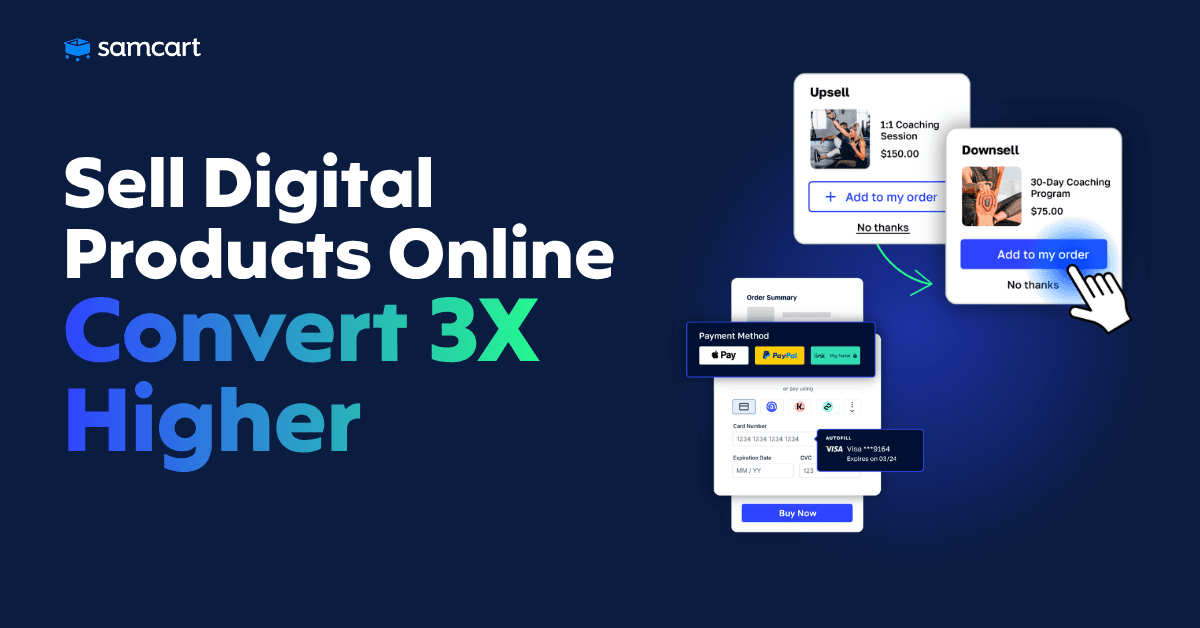
Not a store at all but a checkout: you keep the firm's website and hand buyers a SamCart page for the actual purchase, with upsells, order bumps and payment plans built into that page. It adds no fee of its own on top of card processing when you use its own payment product, which is what justifies the $79 a month entry price for a firm selling a small number of high-value packages. It is the wrong tool for a firm that wants a browsable catalogue, and the right one for a firm selling two or three things very deliberately.
LawPay
The one option here built specifically for law firms, and the only one that addresses trust accounting: it advertises trust account protection and IOLTA compliance, so earned and unearned funds do not land in the same place and processing fees are not deducted from a trust balance. What it sells is not a catalogue but payment: customisable payment pages, payment links, cards on file and scheduled payments, at $19 a month plus 2.99% + $0.30 per card transaction, or 1% for eCheck. A firm taking retainers and invoice payments online usually wants this alongside, not instead of, a store platform.
How we researched this
We read the question as whatever a law firm could sign up for to sell and get paid online: document templates, flat-fee packages, guides, CLE or client courses, and retainer or invoice payments. That excluded the document automation products Rally Legal and Clio Draft, which surfaced in the same searches but do not sell anything, and practice management suites like MyCase, PracticePanther and Smokeball, whose payments side is already represented by LawPay. Big Cartel was set aside as a storefront for artists and makers. Clio and Thinkific were researched too, but their pricing pages would not serve a readable copy, so nothing about them could be quoted.
Plan prices and fee lines are copied in each vendor's own wording, which is why Cheapest paid plan mixes monthly and annual figures and should not be compared line for line. That cell is empty for WooCommerce and Gumroad because neither has a paid plan, and for Wix, Square Online and Ecwid because those vendors show prices only once the page runs in a browser; we left them empty rather than guess. Ecwid and LawPay have no Cost entry because neither page mentions a free plan or trial. These figures are as of September 2026, so reread the fee line on the exact tier you would buy.