Best Nature Preserves Near Madison in Summer for Toddlers
Only one preserve on this list has a swimming beach, and on a hot summer day that makes Governor Nelson State Park the easy choice for a toddler: sand, shallow water and playground equipment beside the picnic area. For a walk instead of a swim, Lakeshore Nature Preserve's flat path out to Picnic Point is the most stroller-friendly on the list, and Stricker's Pond's 0.8-mile gravel loop is short enough for small legs to finish.
Size changes what a toddler outing looks like. The UW Arboretum spreads more than 17 miles of trail over 1,200 acres, so a visit there means one short loop from the Visitor Center, while Stricker's Pond, Acewood and the Mendota unit of Cherokee Marsh are small enough to walk end to end. Dogs are the other sorting question: the City of Madison conservation parks and the Arboretum ban them, while the county parks, Governor Nelson, Pheasant Branch and Lakeshore allow them on a leash.
Our picks
- Sand and shallow water on a hot day: Governor Nelson State Park. The only swimming beach on the list, with playground equipment by the picnic area; a vehicle admission sticker is required.
- Pushing a stroller: Lakeshore Nature Preserve. A wide, flat path to the tip of Picnic Point with benches on the way, and parking at Lot 130 is free on evenings and weekends.
- Birds a two-year-old can hear: Cherokee Marsh Conservation Park - North. Boardwalks looking out over the upper Yahara River and wetlands where sandhill cranes nest, plus restrooms open year-round.
- A loop short enough to finish: Stricker's Pond. A flat 0.8-mile gravel trail around the pond in a 13-acre kettle wetland, with turtles, frogs and wading birds at its edge.
- Playgrounds and restrooms close to the car: Token Creek County Park. Two playgrounds, flush restrooms and drinking water a short walk from parking, plus an elevated boardwalk through a sedge meadow marsh.
At a glance
| Option | Address | Size | Trail Distance | Landscape | Water Feature | Dogs |
|---|---|---|---|---|---|---|
| 1207 Seminole Highway, Madison, WI 53711source | 1,200source | 17source | Mixed woods and prairiesource | Lake shorelinesource | Not allowedsource | |
| 2003 University Bay Drive, Madison, WI 53706source | 300source | 4.3source | Woodlandsource | Lake shorelinesource | Allowed on leashsource | |
| 4864 Pheasant Branch Rd, Middleton, WI 53562source | 682source | 3.3source | Prairie and savannasource | Creek and springssource | Allowed on leashsource | |
| 5140 County Highway M, Waunakee, WI 53597source | 422source | 8source | Prairie and savannasource | Lake shorelinesource | Allowed on leashsource | |
| 6200 US Hwy 51, DeForest, WI 53532source | 418source | Mixed woods and prairiesource | Marshsource | Allowed on leashsource | ||
| 8183 State Highway 19, Cross Plains, WI 53528source | 791source | Kettle lakesource | Allowed on leashsource | |||
| 6098 N. Sherman Ave., Madison, WI 53704source | 946.58source | 4.1source | Prairie and savannasource | River and marshsource | Not allowedsource | |
| 802 Wheeler Road, Madison, WI 53704source | 261.27source | 3.8source | Prairie and savannasource | River and marshsource | Not allowedsource | |
| 4338 Beilfuss Drive, Madison, WI 53704source | 122source | 0.6source | Woodlandsource | Lake shorelinesource | Not allowedsource | |
| 6021 Old Sauk Rd., Madison, WI 53705source | 96.79source | Prairie and savannasource | Pondsource | Not allowedsource | ||
| 802 Femrite Dr., Madison, WI 53716source | 60.27source | 1.4source | Prairie and savannasource | Marshsource | Not allowedsource | |
| 7214 Longmeadow Rd., Madison, WI 53717source | 13.49source | 0.8source | Woodlandsource | Pondsource | Not allowedsource | |
| 1402 Acewood Blvd., Madison, WI 53716source | 38source | Mixed woods and prairiesource | Pondsource | Not allowedsource |





Shade or open sun in July
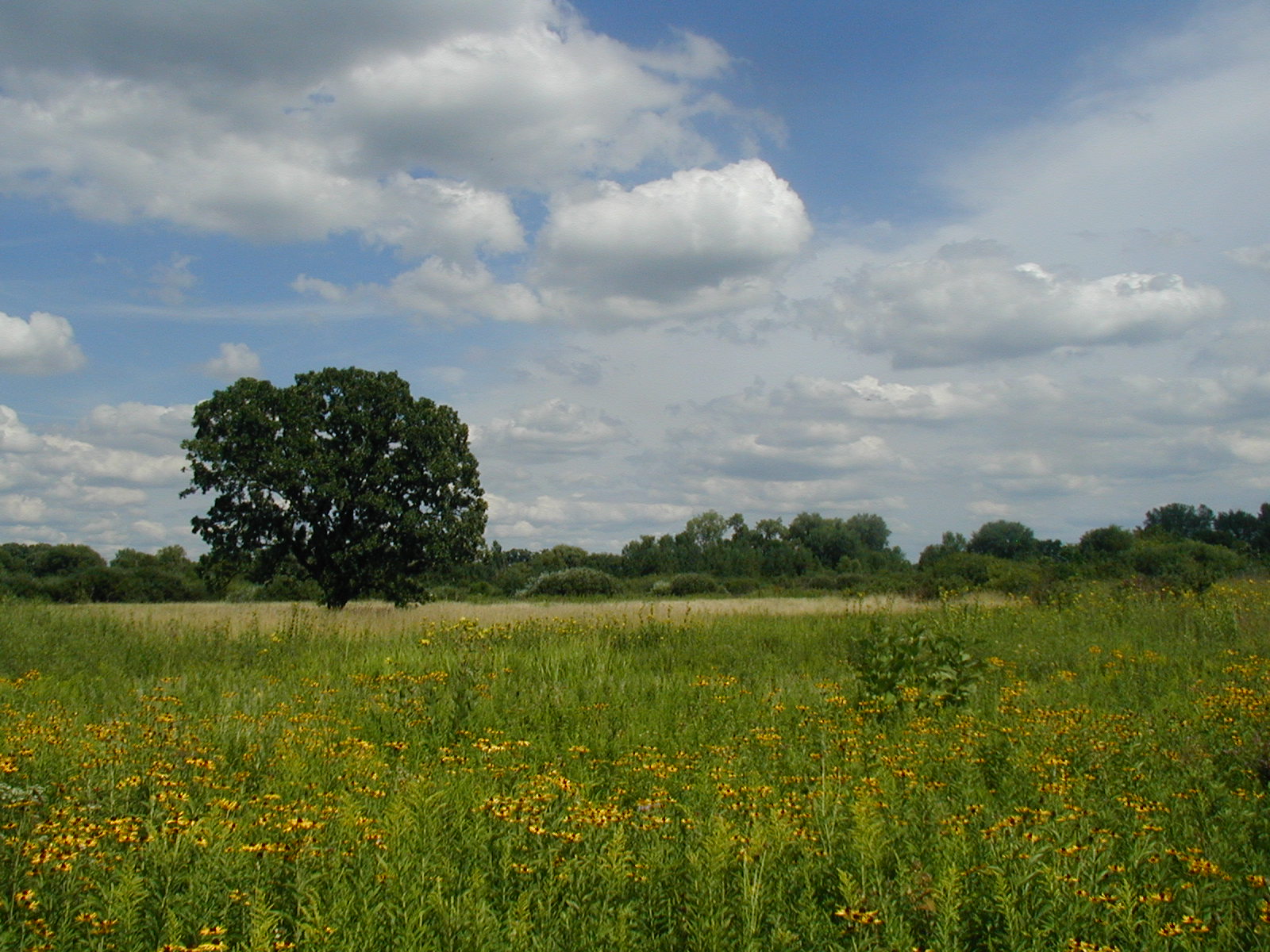
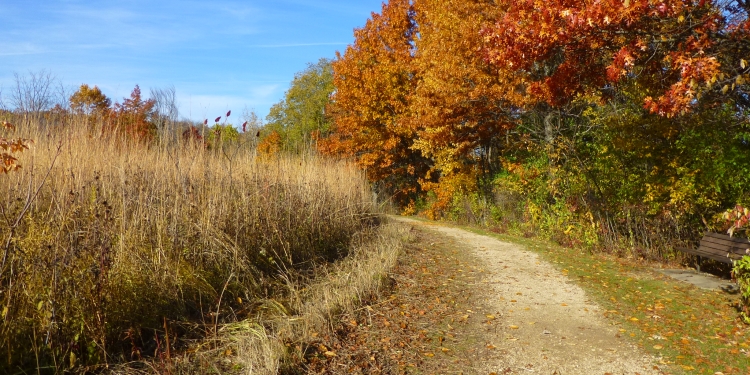
Owen Conservation Park is the sunniest walk here, prairie and oak savanna on a hilltop with very little shade, so it wants hats and water on a hot afternoon. At the other end, Cherokee Marsh Conservation Park - Mendota is 0.6 miles of trail under a closed canopy of red and white oak, black cherry and maple, which makes for a cool, quiet walk in summer.
Restrooms, play equipment and hills to skip
Facilities vary a lot. Token Creek County Park has two playgrounds and flush restrooms by the parking, the Arboretum has restrooms at its Visitor Center, and Cherokee Marsh North and Owen keep restrooms open year-round. Cherokee Marsh South has none, which is the main thing to plan around there.
Two parks have a climb best left for older kids. At Pheasant Branch Conservancy, stick to the short walk from the Pheasant Branch Road lot to the springs and skip the hill. At Indian Lake County Park, the flat lakeside stretch suits a toddler, and the steep climb to the 1857 hilltop chapel does not.
Leashed dogs and off-leash dog parks
Five preserves allow dogs on a leash, with limits. Governor Nelson keeps them off the beach, the picnic area and the shelters. Token Creek has a 33-acre dog park, and Indian Lake has a 38-acre unfenced off-leash area by the boat launch, worth knowing if your child is wary of loose dogs. The eight others, including all six Madison conservation parks and the Arboretum, allow no dogs at all.
The options in detail
University of Wisconsin-Madison Arboretum
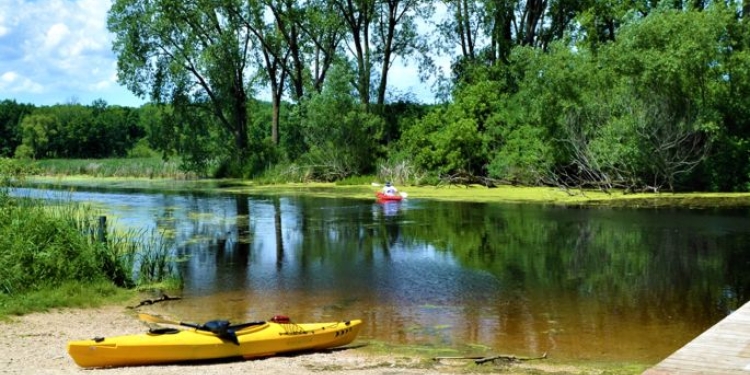
The Arboretum is the big one: 1,200 acres of restored prairie, woods and wetland wrapped around the south shore of Lake Wingra, with more than 17 miles of trails and a Visitor Center that has a library, a bookstore and restrooms. For a toddler the appeal is that you can park at the Visitor Center, walk a short loop through the gardens or out onto a marsh boardwalk, and turn back whenever the walk is over. It is free to visit and the grounds are open from 4 a.m. to 10 p.m. The one catch for families with a dog: pets are not allowed anywhere on the property.
Lakeshore Nature Preserve
Three hundred acres of UW-Madison shoreline, with the Lakeshore Path running the full 4.3 miles from the Memorial Union out past Picnic Point. The classic outing is to park at Lot 130 and walk the wide, flat path to the tip of Picnic Point, stopping at benches on the way and at the narrow portage where Lake Mendota is on both sides at once. It is the most stroller-friendly walk on this list. Parking at Lot 130 is paid on weekdays until 4:30 p.m. and free evenings and weekends, which is worth planning around.
Pheasant Branch Conservancy
A 682-acre conservancy on the north edge of Middleton, owned in pieces by Dane County Parks, the Wisconsin DNR and the City of Middleton. Its signature is a 3.3-mile main loop through prairie and wetland, but the toddler-sized version is the short walk from the Pheasant Branch Road lot to the springs, where cold groundwater bubbles up into a shallow pool small children can crouch over. Observation decks along the way give the walk landmarks to aim for. The climb up Pheasant Branch Hill is the part to skip with small legs, though the view from the top takes in the Capitol and Lake Mendota.
Governor Nelson State Park
The only park on this list with a swimming beach, which makes it the easiest summer sell for toddlers: sand, shallow water and playground equipment beside the picnic area, ten minutes north of Madison on the far shore of Lake Mendota. Away from the beach there are 8 miles of trail through restored prairie and savanna, and Native American effigy mounds along the Woodland Trail. It is a day-use state park, so a vehicle admission sticker is required. Dogs are welcome on an 8-foot leash but not at the beach, the picnic area or the shelters.
Token Creek County Park
418 acres north of Madison built around group outings, which is exactly why it works with small children: two playgrounds, flush restrooms, drinking water and five shelters, all a short walk from the car. The feature worth the drive is an elevated boardwalk through a sedge meadow marsh, which puts a toddler at eye level with frogs and red-winged blackbirds without any mud. There is also a 27-hole disc golf course, a campground and a 33-acre dog park, so expect company on summer weekends. The park does not publish a total trail mileage.
Indian Lake County Park
At 791 acres this is one of Dane County's largest parks, wrapped around a shallow kettle lake west of Cross Plains. Trails reach around the entire lake, and the flat lakeside stretch is the toddler portion; the well-known winding climb to the 1857 hilltop chapel is steep and better saved for older children. Play equipment, a shelter and a log cabin sit near the main entrance off Highway 19. A 38-acre unfenced off-leash dog park occupies the west side by the boat launch, which is worth knowing if your child is nervous around loose dogs.
Cherokee Marsh Conservation Park - North
The North Unit is the best marsh walk close to Madison: 946 acres of restored prairie, oak savanna and woodland, with boardwalks and observation decks looking out over the upper Yahara River, deep marsh and sedge meadow. Sandhill cranes nest in the wetlands and are often both visible and audible from the boardwalk, which is the kind of thing that holds a two-year-old's attention. There are 4.1 miles of trail and, unusually for a Madison conservation park, restrooms open year-round. Free volunteer-led nature walks run monthly. Dogs are not allowed in any conservation park.
Cherokee Marsh Conservation Park - South
The quieter southern half of Cherokee Marsh: 261 acres and 3.8 miles of trail over high ground that looks down on sedge meadow, deep marsh and the upper Yahara River. Three constructed ponds beside the trails filter urban stormwater and pull in herons, wood ducks and kingfishers. A gravel boat launch and pier give river access, so you can end the walk at the water. There are no restrooms at this unit, which is the main thing to plan around with a toddler.
Cherokee Marsh Conservation Park - Mendota
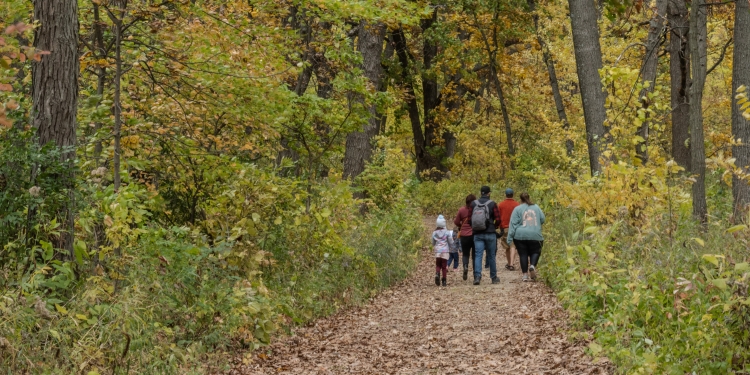
The smallest of the three Cherokee Marsh units and the shadiest: 122 acres of lowland forest with large red and white oak, black cherry and maple, and only 0.6 miles of trail in total. That short distance is the point with a toddler, and the park's wetlands run out to the Lake Mendota shoreline. Spring brings a dense wildflower floor of Dutchman's breeches and white trout lily; in summer it is mostly a cool, quiet walk under a closed canopy. Barred owl, nuthatch and woodpeckers are regular here.
Owen Conservation Park
97 acres of prairie and oak savanna on a hilltop above Madison's west side, once the farm and retreat of a UW professor. It is the most open, sunniest walk on this list, with wide paths, big sky and coneflowers, goldenrod and bluestem through the summer, plus three small stormwater and wildlife ponds in the southwest corner. Restrooms are open year-round, which is rare for a Madison conservation park. There is very little shade, so bring hats and water on a hot afternoon.
Edna Taylor Conservation Park
60 acres in southeast Madison built around a glacial drumlin that rises out of a broad ribbon of marsh, with 1.4 miles of trail, a small parking lot and a boardwalk over the wet ground. The Aldo Leopold Nature Center next door uses the park heavily for environmental education, so the trails are already laid out with children in mind. Effigy mounds are part of the site. Ongoing restoration is returning the uplands to oak savanna and the low ground to wetland.
Stricker's Pond
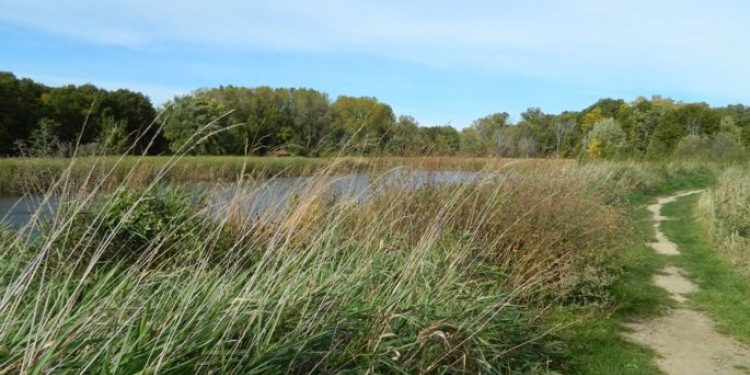
A 13-acre kettle wetland on Madison's west side, left behind when a buried block of glacial ice melted. A 0.8-mile gravel trail runs the pond's perimeter and continues north into Middleton parkland, and the whole circuit is flat and short enough for small legs. The pond edge is reliably busy with turtles, frogs and wading birds, and large numbers of waterfowl stop here in spring and fall. The trail was resurfaced and a new footbridge added in 2017. This is a neighborhood-scale outing rather than a destination, which is often exactly what you want.
Acewood Conservation Park
Madison Parks describes this 38-acre park as great for summertime hikes with family, and that is a fair summary: wooded paths, a pond with a bench looking out over it, and restored prairie, all backing onto the neighborhood's Acewood Park. Three access points, off Deerwood Drive, Acewood Boulevard and Leo Drive, mean you can start close to wherever you park. The city does not publish a trail mileage here, but the walkable loop is short. Dogs are not allowed, as in every Madison conservation park.
How we researched this
Acreage and trail mileage are the managing agency's own figures wherever it publishes them, so Token Creek and Indian Lake carry Dane County's 418 and 791 acres rather than the 427 and 483 on a tourism listing. The Size column is not perfectly like for like: Pheasant Branch's 682 acres add up three separately managed pieces, and Governor Nelson's 422 comes from an encyclopedia entry because the state's own page gives no acreage. Empty trail distances mean the agency's page gives no figure; Owen lists only its ski trails, which would be the wrong number for a walk.
Pope Farm Conservancy is missing because its site gives neither acreage nor trail length, and the Aldo Leopold Nature Center is a nature center rather than a preserve (it borders Edna Taylor, where its programs use the trails). Restrooms are in the write-ups where a park lists them, not in a column, since most park pages do not say either way. Before you go, note that Lakeshore's Lot 130 is paid on weekdays until 4:30 p.m. and Governor Nelson needs a state park sticker on the car.