best table saws for small shops
Updated .
| Option | Price | Motor | Power Supply | Rip Capacity | Weight | Dust Port |
|---|---|---|---|---|---|---|
The cheapest honest way into a full-size 10 inch saw. You get a rack and pinion fence that stays square, legs that fold into a stand, and a coated cast aluminum top, all light enough to stand in a corner between projects. The trade-offs are the ones every saw at this price makes: a universal motor that is loud and a lighter table that shows more vibration than cast iron, and the dado insert takes an 8 inch stack rather than a 10 inch one. For a first shop, or as a saw you carry outside to break down sheet goods, it is hard to argue with. | $329.99source | 15 ampsource | 120V householdsource | 25.5source | ||
A portable saw with two things you rarely see in this class: a variable speed motor with constant torque, and a blade you can swap for a 10 inch sanding disc, which makes it a disc sander when you need one. It also comes with a magnetic switch, a riving knife and onboard storage, so nothing important is sold separately. The aluminum table keeps it liftable, and there is a built in port sized for a shop vacuum. Oliver is a smaller name than SKIL or DeWalt, so expect fewer aftermarket parts and a thinner used market. | $499.99source | 2 HPsource | 120V householdsource | 28source | 90source | 2-1/2 in.source |
SawStop's smallest saw, and the cheapest way to get the skin contact brake that stops and drops the blade on contact. It is built like the rest of the line rather than like a budget saw: a rack and pinion fence that stays square, one knob for both height and tilt with a micro adjust, and rubber feet on a rigid tube frame. Two real limits: the page states plainly that it will not accept a dado blade, and the rip capacity is the narrowest of the corded saws here. If you work alone and the brake is why you are shopping, this is where the line starts. | $899source | 15 ampsource | 120V householdsource | 68source | ||
The entry point to cabinet style saws that still plug into a normal outlet. It has the things that actually separate a shop saw from a jobsite saw: a precision ground cast iron table, cast aluminum trunnions, an induction motor on a belt, and a sealed base that pulls dust from above and below the blade. Laguna pitches it at people upgrading from a portable saw or buying their first enclosed saw, and the footprint is deliberately small. The compromises against the F2 are the single rail fence and steel rather than cast iron wings. | $1,399source | 1.5 HPsource | 120V householdsource | 30source | 200source | 3-7/8 in.source |
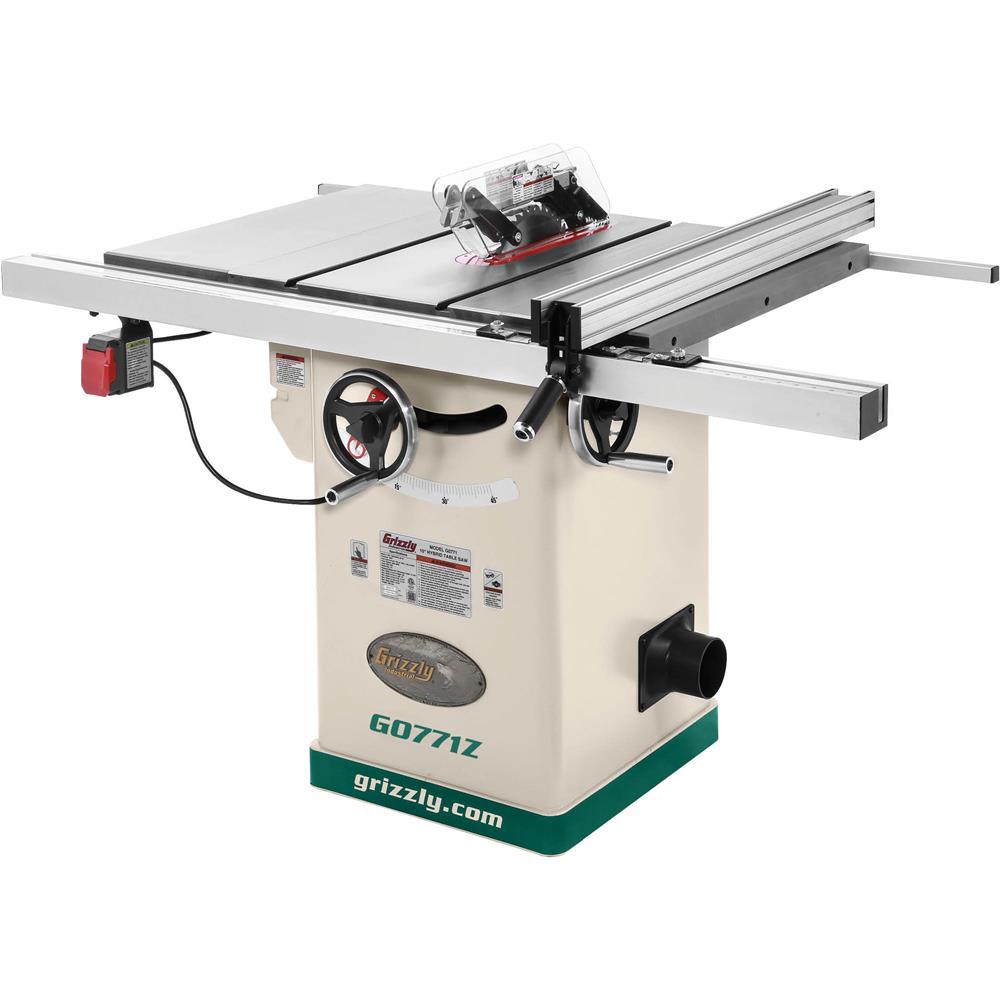
Grizzly's own page calls this the best hybrid option for small shops, and the spec sheet backs it up: an enclosed steel cabinet, cast iron table and trunnions, a quick release riving knife, and a fence Grizzly assembled from the best parts of three of its older designs. It arrives prewired for an ordinary household circuit, which is the whole point of a hybrid, and the cabinet routes dust to a full size collector port. Grizzly publishes only a shipping weight, so budget for freight delivery and a mobile base if the saw has to move. | $1,450source | 2 HPsource | Convertible 120V/240Vsource | 30source | 4 in.source | |
The outlier here, and the right answer for the smallest shops of all. It is a battery saw that packs into a Systainer, so it can live on a shelf and come out onto a bench or a pair of sawhorses. Blade height and bevel are set electrically from a digital display rather than by eye, and you can store four blade positions, which makes repeat cuts genuinely repeatable. What you give up is capacity: the cut width and cut height are a fraction of any corded saw on this list, so treat it as a precision saw for small parts, not as your only saw. | $1,499source | Cordless 18Vsource | Cordless batterysource | 11source | 45source | 1-1/16 in.source |
The skin contact brake on a cart that folds up and rolls into a corner, which is exactly the shape a crowded garage wants. The fence is a solid Hi-Lo T-style with a positive lock, the blade raises with one turn of a hand wheel rather than a long crank, and the blade guard pulls dust from above the table as well as below. Compared with the Compact it buys you a deeper table, more rip, and a stand you do not have to build. It is still a universal motor, so it is loud, and it costs about what a real cabinet style saw with more capacity costs. | $1,699source | 15 ampsource | 120V householdsource | 25.5source | 113source | |
This is the cheapest SawStop with an induction motor and a cast iron table, which is the jump that changes how a saw feels to use: quieter, smoother, and steadier under a wide board. It keeps the brake, adds a full size dust port, and the motor can be rewired for 240V later if the shop gets a circuit. It ships on an open stand with stamped wings, so cast iron wings, an outfeed table and a mobile base are all extras. SawStop's page lists a shipping weight rather than a machine weight and does not print a rip figure, which is why two cells in this row are blank. | $1,999source | 1.75 HPsource | Convertible 120V/240Vsource | 4 in.source | ||
The F1 with the upgrades that matter most in daily use: cast iron wings instead of steel, a double rail cam action fence, and a digital readout for blade tilt so a bevel is set by number rather than by squinting at a scale. The feature small shops will care about most is the built in mobile base, which means the saw can be rolled out for a project and pushed back against a wall afterwards. Dust is pulled from above and below the blade with a sealed base. It is heavy and arrives by freight, so plan where it goes before it turns up. | $1,999source | 1.75 HPsource | 120V householdsource | 36source | 276source | 3-7/8 in.source |
A long running shop saw that Jet aims squarely at home workshops and small businesses. The details are the sort you notice after a year rather than in the store: a magnetic paddle switch you can slap off with a knee, a quick release riving knife so it actually gets put back, an arbor lock for one wrench blade changes, and onboard storage for every accessory it ships with. The table is cast iron with stamped steel wings, which is the compromise that holds the price down and the part to upgrade first. Jet asks for a 20 amp circuit, so check the garage before ordering. | $2,089source | 1.75 HPsource | 120V householdsource | 30source | 236source | 4 in.source |
The most machine per dollar in this group if you can live with the mass. It is built around a heavy cast iron trunnion and the Accu-Fence, which locks to the rail without play, and it adds the small quality of life pieces: an arbor lock reachable from above the table, a rack and pinion miter gauge with an extension plate, and a melamine extension table that widens the work area. The motor is dual voltage, so it can start on a household circuit and be rewired later. Two things to budget for: the blade is not included, and nothing this heavy moves without a mobile base. | $2,606source | 1.75 HPsource | Convertible 120V/240Vsource | 30source | 366.85source | 4 in.source |
A genuine cabinet saw with the skin contact brake that still runs on a normal household circuit, which is the combination most home shops are actually looking for. The enclosed cabinet, heavy trunnions and belt drive make it the smoothest and quietest saw here, and the sealed body means dust leaves through the port rather than onto the floor. SawStop's own page is candid that 30 inches of rip handles cabinet parts and half sheets comfortably but wants outfeed support for full sheets. The costs to weigh are the price and the brake cartridge, which is a consumable if you ever trigger it. | $3,025source | 1.75 HPsource | 120V householdsource | 30source | 367source | 4 in.source |
The one saw here that needs a 240V circuit, and the reason to want one. Three horsepower is what stops a saw bogging in thick hardwood, and the F3 pairs it with cast iron trunnions, a 14 gauge steel cabinet, a digital bevel readout and two fences, including the industrial Fusion fence. Like the smaller Fusions it has a built in mobile base and dust collection over and under the blade, so it still suits a shop where the saw has to be pushed aside. If the garage has only standard outlets, this is a saw plus an electrician. | $3,149source | 3 HPsource | 240V onlysource | 36source | 385source | 3-7/8 in.source |
The default recommendation for a garage shop, and it earns it on rip capacity: the telescoping rack and pinion fence pulls out far enough to break down a full sheet of plywood, then retracts so the saw takes up almost no floor. The rolling stand sets up and folds down in one motion, and every accessory stores on the saw itself, which matters when there is no wall to hang things on. It is still a jobsite saw, so the top is aluminum and the universal motor is loud next to an induction saw. If you want maximum capacity per dollar and per square foot, this is the one to beat. | $699source | 15 ampsource | 120V householdsource | 32.5source |