Open Source VPN Software
Nineteen open source VPN tools compared on type, license, protocols, platforms and admin style, from WireGuard and OpenVPN to NetBird and Headscale. Read our take
At a glance
| Option | Type | License | Protocols | Runs on | Managed from |
|---|---|---|---|---|---|
| VPN protocolsource | GPL-2.0source | WireGuardsource | Linux, Windows, macOS, BSD, iOS, Androidsource | Command line and config filessource | |
| VPN serversource | GPL-2.0source | OpenVPNsource | Windows, Linux, BSD, macOSsource | Command line and config filessource | |
| VPN serversource | Apache-2.0source | Own protocol, WireGuard, OpenVPN, IPsec/IKEv2, L2TP, SSTPsource | Windows, Linux, macOS, BSDsource | Web admin panelsource | |
| IPsec suitesource | GPL-2.0source | IPsec/IKEv2source | Linux, Android, BSD, macOS, iOS, Windowssource | Command line and config filessource | |
| IPsec suitesource | GPL-2.0source | IPsec/IKEv2source | Linux, BSD, macOSsource | Command line and config filessource | |
| VPN serversource | GPL-2.0source | AnyConnectsource | Linuxsource | Command line and config filessource | |
| Mesh networksource | GPL-2.0source | Own protocolsource | Linux, BSD, macOS, Windowssource | Command line and config filessource | |
| Mesh networksource | MITsource | Own protocolsource | Linux, macOS, Windows, iOS, Android, BSDsource | Command line and config filessource | |
| Mesh networksource | Open coresource | Own protocolsource | Windows, macOS, iOS, Android, Linux, BSDsource | ||
| Mesh networksource | BSD-3-Clausesource | WireGuardsource | Linux, BSDsource | Command line and config filessource | |
| Mesh networksource | BSD-3-Clausesource | WireGuardsource | Linux, macOS, Windows, Android, iOSsource | Web admin panelsource | |
| Mesh networksource | MITsource | WireGuardsource | Linux, macOSsource | Command line and config filessource | |
| Remote access platformsource | Open coresource | WireGuardsource | Windows, macOS, Linux, iOS, Androidsource | Web admin panelsource | |
| Setup toolsource | AGPL-3.0source | WireGuardsource | Linuxsource | Web admin panelsource | |
| Setup toolsource | AGPL-3.0source | WireGuard, IPsec/IKEv2source | Linux, macOS, Windowssource | Command line and config filessource | |
| Setup toolsource | GPL-3.0source | OpenVPN, WireGuard, IPsec/IKEv2, Shadowsockssource | Windows, macOS, Linux, Android, iOSsource | Desktop appsource | |
| VPN serversource | Apache-2.0source | Shadowsockssource | Android, Windows, iOS, macOS, Linuxsource | Desktop appsource | |
| Mesh networksource | Open coresource | WireGuardsource | Linux, Windows, macOSsource | Web admin panelsource | |
| Setup toolsource | MITsource | OpenVPN, WireGuardsource | Linuxsource | Command line and config filessource |










Our take
For most people running their own VPN today, the answer is WireGuard or a tool built on it. WireGuard itself is GPL-2.0 and runs on Linux, Windows, macOS, BSD, iOS and Android, and wg-easy wraps it in a web admin panel on any Linux host, which is the quickest way to give a household or a few friends one private server. If a whole team needs to share one private network with sign-on and access rules, NetBird is the fully open source mesh in this table with its own web admin panel, BSD-3-Clause on the client and AGPLv3 on the servers.
The real split in this set is between hub VPNs and mesh networks. OpenVPN Community Edition, SoftEther VPN, strongSwan, Libreswan, ocserv, Outline and the setup tools all point every device at one server, which suits reaching the internet or one office network. tinc, Nebula, ZeroTier, Headscale, NetBird, Netmaker and innernet connect devices to each other directly, which suits linking laptops, home servers and cloud machines into one private network. The second split is how open the whole stack is: Firezone, Netmaker and ZeroTier are marked Open core because part of their code is source-available rather than open source.
Our picks
- Simplest personal VPN: wg-easy. WireGuard plus a web admin panel on any Linux host, under AGPL-3.0.
- Best for a team network: NetBird. A WireGuard mesh with a web admin panel and clients for Linux, macOS, Windows, Android and iOS.
- Most protocols on one server: SoftEther VPN. Speaks its own protocol plus WireGuard, OpenVPN, IPsec/IKEv2, L2TP and SSTP, under Apache-2.0.
- Best for built-in phone and laptop VPN settings: strongSwan. An IPsec/IKEv2 suite that runs on Linux, Android, BSD, macOS, iOS and Windows.
- Best where VPNs get blocked: AmneziaVPN. One desktop app that sets up OpenVPN, WireGuard, IPsec/IKEv2 or Shadowsocks on your own server.
Hub VPN or mesh network
A hub VPN sends every device through one server you run. WireGuard, OpenVPN Community Edition and ocserv are that server in its plainest form, configured with the command line and config files, while wg-easy and Algo VPN install and manage a WireGuard server for you, and PiVPN does the same for OpenVPN or WireGuard on a Raspberry Pi or a small Linux server. This is the right shape when the goal is safer browsing on public Wi-Fi or reaching one office or home network.
A mesh network lets each device reach every other directly, so a laptop can talk to a home server without everything passing through a central box. tinc, Nebula and innernet do this with config files or the command line; NetBird adds a web admin panel, single sign-on and group access rules, and Netmaker offers a similar admin UI with its Pro features under a separate license; Headscale gives you a self-hosted server for Tailscale's client apps. Firezone sits between the two as a remote access platform that grants people access to specific internal resources rather than the whole network.
Which open source VPNs are open all the way down
Most of this table is under a standard open source license end to end, from GPL-2.0 for WireGuard, OpenVPN, strongSwan, Libreswan, ocserv and tinc to MIT for Nebula, innernet and PiVPN. Three are Open core: Firezone keeps its admin portal and control plane under the Elastic License 2.0 and says production self-hosting is not officially supported, Netmaker keeps its pro/ directory under its own Pro license with the rest under Apache 2.0, and ZeroTier marks parts of its repository as non-free and source-available beside its Mozilla Public License 2.0 core.
Two subtler cases are worth checking before you commit. NetBird's client is BSD-3-Clause but its management, signal and relay servers are AGPLv3, which matters only if you plan to modify and offer them to others. Headscale is BSD-3-Clause, but it relies on Tailscale's client apps, and Tailscale's graphical clients for Windows, macOS and iOS are not open source.
Getting through networks that block VPN traffic
On networks that filter VPNs, the protocol matters more than the brand. Outline runs a Shadowsocks proxy that its makers describe as harder to block, AmneziaVPN adds disguised options such as OpenVPN over Cloak and Shadowsocks, ocserv carries traffic over standard TLS and Datagram TLS using the AnyConnect protocol, and SoftEther VPN's own SSL-VPN protocol is built to pass through firewalls. Self-hosting guides single out plain WireGuard as the traffic that gets blocked first, which is why they point to AmneziaVPN for those networks.
The options in detail
WireGuard
The protocol most of the newer tools in this table are built on, and also a complete VPN by itself: two machines exchange short public keys, much like SSH keys, and the tunnel comes up. Its kernel code ships inside Linux, and the project says it was designed to be small enough for one person to audit, unlike the far larger IPsec and OpenVPN codebases. There is no admin panel: you configure it with the wg command and plain config files, which is exactly the gap wg-easy, NetBird and Headscale fill.
OpenVPN Community Edition
The long-standing open source VPN daemon, licensed GPLv2 and tested on Windows, Linux, FreeBSD and macOS with every source commit. Nearly every router, firewall and VPN client already speaks its protocol, which is why self-hosting guides still treat it as the fallback for older or restrictive networks. Setup is manual: the community how-to walks you through creating your own certificate authority and writing configuration files for the server and each client. The company behind it also sells Access Server and a hosted service; this free community edition is the open source part.
SoftEther VPN
An academic project from the University of Tsukuba that speaks more protocols than anything else here: its own SSL-VPN plus OpenVPN, WireGuard, IPsec, L2TP and Microsoft's SSTP, so one server can accept the VPN clients built into most phones and laptops. It includes a built-in HTML5 web administration console as well as the Windows server manager shown here, and it moved from the GPL to the Apache 2.0 license. The breadth is also the cost: virtual hubs, LAN bridging, dynamic DNS and NAT traversal make it a bigger system to learn than a single-purpose tool.
strongSwan
A full IPsec implementation centred on the IKEv2 key exchange, the standard many devices can already use from their built-in VPN settings, so clients often need no extra app. It runs on Linux and has been ported to Android, FreeBSD, macOS, iOS and Windows, with an Android app and a NetworkManager plugin for Linux desktops. It is driven by the swanctl command and config files, and the GPLv2 edition sits beside paid commercial licensing. Expect a steeper climb than WireGuard: its feature list cites dozens of RFCs.
Libreswan
The IPsec implementation that ships with Fedora, RHEL and Arch Linux, descended from the FreeS/WAN project founded in 1997, so on a Red Hat style server it is usually one package install away. It supports IKE versions 1 and 2, uses the Linux kernel's built-in IPsec stack and the NSS crypto library, and is configured through ipsec.conf. Choose it over strongSwan mainly when your distribution already standardises on it; for phones it has no apps of its own.
OpenConnect VPN Server (ocserv)
The server half of the OpenConnect project: a Linux SSL VPN server that follows Cisco's AnyConnect protocol, so OpenConnect and AnyConnect-compatible clients can connect to it. It is aimed at organisations, with logins through RADIUS, OpenID Connect, Kerberos or smart cards, two-factor authentication and RADIUS accounting reports. Traffic is secured with standard TLS and Datagram TLS, and the project says performance scales with CPU count to thousands of clients. It is configured from a single file, with no web console.
tinc
A long-running mesh VPN daemon: however you chain the nodes together, traffic is sent directly to its destination when possible, and NAT traversal works as long as one node accepts incoming connections. Adding a node means adding one configuration file, and it can bridge Ethernet segments so LAN-only software works across the internet. It runs on Linux, the BSDs, macOS, Solaris and Windows under GPLv2 or later. Development is slow: the site says 1.0.37 will most likely be the last release of the 1.0 line.
Nebula
An overlay network that came out of Slack (its MIT license is held by Slack Technologies) and is now documented by Defined Networking. Each host carries a certificate signed by your own certificate authority, finds peers through lighthouse nodes, then talks to them directly over a protocol built on the Noise Protocol Framework. It runs on Linux, macOS, Windows, iOS, Android and FreeBSD and is set up with a config.yml per host. Defined Networking also sells a managed version with a web UI and SSO for teams that would rather not run the certificate authority themselves.
ZeroTier
A peer-to-peer virtual network that behaves like one big Ethernet switch, so devices see each other as if they sat in the same building, with free but slow relaying when a direct connection cannot be made. Apps cover Windows, macOS, iOS, Android, Linux and FreeBSD. The core agent is under the Mozilla Public License 2.0, but parts of the repository are marked non-free and source-available, and the self-hosted network controller is driven through its JSON API rather than a web panel.
Headscale
An open source, self-hosted replacement for the Tailscale coordination server, so you can use Tailscale's client apps without an account on Tailscale's service. It deliberately keeps a narrow scope, one tailnet for personal use or a small organisation, runs on a modern Linux or BSD server, and is administered from the command line, with community web UIs listed in its docs. One catch for purists: Tailscale's own GUI clients for Windows, macOS and iOS are not open source, only the Linux and Android ones are.
NetBird
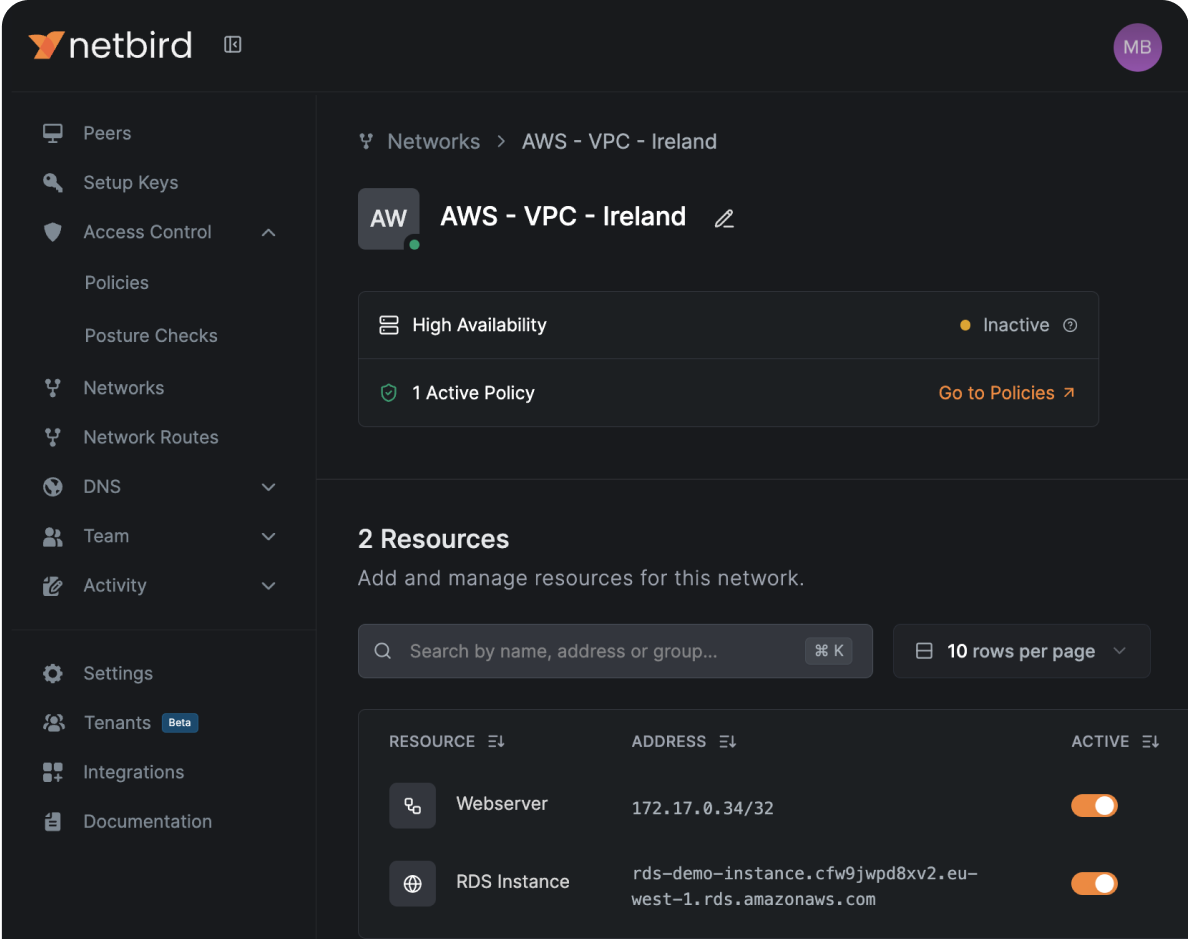
A WireGuard mesh with the management layer included: the client, the management server and the admin web UI are all open source and can be self-hosted with a quickstart script, or used as NetBird's hosted service. It adds single sign-on and MFA, group-based access rules, posture checks and activity logs, which is what lifts it above a bare WireGuard setup for a team. The client code is BSD-3-Clause while the management, signal and relay servers are AGPLv3.
innernet
A small WireGuard-based private network from the Japanese company tonari, built around address ranges: you group peers into CIDRs and decide which ranges may talk to each other, all from the command line. Its authors compare it to Nebula and Tailscale but lean on existing networking concepts rather than a new control layer. The README is candid that it has had no independent security audit and should be treated as experimental, and it is officially tested only on Linux and macOS.
Firezone
A zero-trust remote access platform built on WireGuard: rather than joining everyone to one flat network, admins grant groups access to specific resources through policies, with device trust checks and detailed audit logs. The clients and gateway are Apache 2.0, but the admin portal and control plane are under the Elastic License 2.0, which is source-available rather than open source, and the README says production self-hosting is not officially supported. In practice that makes it open source software you pair with Firezone's managed service.
wg-easy
The shortest route from a blank Linux server to a working WireGuard VPN: one container that bundles WireGuard with a web admin page where you add and disable clients, show a QR code for each phone, and watch per-client traffic charts. Every device connects to that one server, so it suits a personal or household VPN rather than a mesh of machines. It is AGPL-3.0 licensed.
Algo VPN
A set of Ansible scripts from the security firm Trail of Bits that builds a personal WireGuard and IPsec VPN server in the cloud in one run, with deliberately strict defaults. It generates WireGuard config files and QR codes for each device, plus Apple profiles that set up IPsec on iPhones and Macs with no extra app, and it can block ads. There is no admin panel: you add or remove users with its helper scripts. AGPLv3.
AmneziaVPN
A desktop and mobile app that also installs the server: give it a server's IP address and SSH login and it sets up VPN containers there and connects you. Beside classic OpenVPN, WireGuard and IKEv2 it offers disguised options such as OpenVPN over Cloak, Shadowsocks, its own AmneziaWG and XRay, which is why self-hosting guides point to it where WireGuard traffic gets blocked. The app is GPLv3; the company also sells a paid hosted subscription beside the free self-hosted route.
Outline
Developed by Jigsaw to help people reach the open internet under censorship: you run a Shadowsocks-based server on a cloud provider or your own Linux machine, then hand out access keys to friends or colleagues, with optional data limits per key. Setup runs through the Outline Manager desktop app, and the server is Apache 2.0. Strictly it is an encrypted proxy rather than a network VPN, so it will not link your own machines together the way the mesh tools here do.
Netmaker
A WireGuard automation platform from a Y Combinator company that builds mesh, site-to-site and remote access networks, managed from an admin UI with OAuth sign-in and access control lists. The open source server installs on a cloud VM with a static public IP through a quick-install script, and devices join through its netclient agent or plain WireGuard config files, which also brings routers in. The README says code outside its pro/ directory is Apache 2.0 while the Pro features carry their own license, and the company also sells a hosted version.
PiVPN
A set of shell scripts that turns a Raspberry Pi, or any x86_64 machine running Ubuntu or Debian, into an OpenVPN or WireGuard server with one install command, then adds and removes clients with the pivpn command. It is built for a cheap VPN back into a home network and runs alongside Pi-hole. Its 2024 release announced the end of active development; a maintainer has since kept it going on a best-effort basis, updating it for new distribution releases, so large new features are unlikely.
How we researched this
We read each project's own website, documentation and source repository, including its README and LICENSE files, for what kind of software it is, its license, the protocols it speaks, the operating systems it names and how it is managed, and recorded each value with the sentence it came from. The set is VPN software you run yourself: protocols, servers, IPsec suites, mesh networks and setup tools. Consumer VPN subscriptions with open source apps, such as Mullvad or Proton VPN, are a different purchase and are not included.
We left out Pritunl, whose license allows non-commercial use only and forbids distributing modified code, OpenVPN Access Server, which is proprietary, and Tailscale's own coordination server, which is closed (Headscale stands in for it). The one blank cell is ZeroTier's Managed from: its self-hosted controller is driven through API calls, which fits none of the three choices. Platforms are listed as each project names them, so a missing operating system means the project does not list it, and licenses change between releases, so check the repository before you deploy.