Best Help Desk Software for Small Business Free
Free help desks for a small business come in two kinds, and this table splits almost evenly between them. If nobody on staff wants to run a server, Jira Service Management gives three agents a free desk that takes requests by email, chat and a customer portal; if you can manage a web host, FreeScout and Hesk cost nothing and have no agent limit.
The hosted free plans are generous on convenience and strict on seats: HubSpot Service Hub and Chatwoot's cloud stop at two, Zoho Desk and Jira at three. tawk.to and Odoo Helpdesk are the hosted exceptions with unlimited users, tawk.to because it earns from hiring out chat agents rather than from seats, and Odoo only while Helpdesk is the one Odoo app you run. The self-hosted five swap that seat math for the work of patching a server.
Our picks
- Tickets tied to your customer records: HubSpot Service Hub. Two users get a shared inbox, ticketing and live chat sitting on the free CRM, so every conversation lands on a contact record.
- Answering website visitors: tawk.to. Unlimited agents, chat volume and sites at no charge; you pay only for add-ons, such as Whitelabel from $29 a month.
- Internal IT support: Spiceworks Cloud Help Desk. The Core plan is free for one to five technicians with a web portal for raising tickets, paid for by ads that $5 per seat removes.
- A shared inbox on ordinary PHP hosting: FreeScout. Unlimited agents on ordinary PHP and MySQL hosting, gathering email, WhatsApp, Telegram, Facebook, Slack and live chat into one place.
- A complete ticket system without a subscription: Zammad. The self-hosted GPL v3 build carries the full feature set, including email, web form, SMS, chat and Telegram.
At a glance
| Option | Free plan seats | Paid plans from | Channels | Free version runs on |
|---|---|---|---|---|
| 3 userssource | $7 per user/month, billed annuallysource | Emailsource | ||
| 3 agentssource | $20 per agent/monthsource | Email, chat and a customer portalsource | The vendor's serverssource | |
| 2 userssource | $7 per seat/month, billed annuallysource | Ticketing, a shared inbox and live chatsource | ||
| 1-5 seatssource | $5 per seat/month, billed annuallysource | Email and a web portalsource | The vendor's serverssource | |
| 2 agents on the free cloud plansource | $19 per agent/month, billed annuallysource | Live chat on the free plansource | Eithersource | |
| Unlimitedsource | Free; add-ons such as Whitelabel from $29/monthsource | Live chat and an omnichannel inboxsource | The vendor's serverssource | |
| Unlimited users on the free one-app plansource | $31.10 per user/month on the Standard plansource | Email, live chat and WhatsAppsource | The vendor's serverssource | |
| Hosted SupportSystem from $12 per agent/monthsource | Email, web forms and APIsource | Your own serversource | ||
| Unlimitedsource | Free; optional modules sold separately under a lifetime licencesource | Email, WhatsApp, Telegram, Facebook, Slack and live chatsource | Your own serversource | |
| Unlimitedsource | Hesk Cloud from $299/yearsource | Your own serversource | ||
| Unlimitedsource | $8 per agent/month billed annually, two-agent minimumsource | Email, web forms and social mediasource | Your own serversource | |
| Hosted plans from EUR 7 per agent/monthsource | Email, web form, SMS, chat and Telegramsource | Your own serversource |








What the hosted free plans leave out
Seats are only half the limit. Zoho Desk's free edition covers three users but only email tickets, with live chat and the knowledge base waiting on a paid edition, the cheapest being $7 Express. Chatwoot's free cloud plan allows two agents, 500 conversations a month and live chat only, and HubSpot keeps its knowledge base and customer portal in the Professional tier.
Jira Service Management takes requests through several routes at once on its free plan: a portal, email, an embedded widget and chat in Microsoft Teams or Slack. Its vocabulary of incidents and change management is built for IT and internal service teams, as is Spiceworks, so a shop answering customers may find both a slightly awkward fit.
The first paid step, and what it buys
Outgrowing the free tier costs very different amounts. Spiceworks goes to $5 a seat, Zoho and HubSpot to $7 per user or seat billed annually, Chatwoot to $19 per agent and Jira to $20 per agent. Odoo Helpdesk jumps to $31.10 per user on Standard, but only when you add a second Odoo app, not because your team grew.
Most of the self-hosted tools sell hosting too if you tire of running a server. Zammad's hosted plans start at EUR 7 per agent, UVdesk's at $8 per agent with a two-agent minimum, and osTicket's sibling SupportSystem at $12 per agent. Hesk Cloud is the odd one out, $299 a year flat whatever your agent count.
Running a help desk on your own server
osTicket, FreeScout and Hesk all run on PHP hosting, and Hesk's paid license only removes its Powered by Hesk credit, so the free build is the full product. FreeScout is leaner at its core and sells tags, time tracking and chat as separate modules on a lifetime license per installation, so a working setup usually means buying a few.
Zammad asks more of your server, wanting Ruby, Elasticsearch and PostgreSQL rather than an upload of PHP files. UVdesk is built on Symfony with integrations for marketplace sellers, which suits an online store more than a services business, and Chatwoot's self-hosted Community Edition drops the two-agent cap of its cloud plan.
The options in detail
Zoho Desk
Zoho's free edition is the classic starting point for a very small support team: three user licences, email ticketing, and an easy path into the rest of Zoho's suite if you already use it. Zoho is explicit that the free plan is email ticketing right out of the box, so live chat, instant messaging and the knowledge base only arrive once you move to a paid edition, the cheapest being Express at US$7 per user a month. It suits a team that expects to grow into paid tiers rather than stay free forever.
Jira Service Management
Atlassian's service desk is free forever for three agents and, unusually for a free tier, takes requests through several routes at once: a customer portal, email, an embedded widget and chat in Microsoft Teams or Slack, plus alerting and on-call schedules. It is built around IT and internal service teams, so its vocabulary of requests, incidents and change management fits an internal help desk better than a customer-facing one. The step up to Standard is a steep $20 per agent a month, and it is worth checking whether your team will use the ITSM machinery before committing.
HubSpot Service Hub
HubSpot's free tier gives two users a shared inbox, ticketing and live chat sitting directly on the free HubSpot CRM, so every conversation is attached to a contact record without any integration work. That CRM tie is why most small businesses pick it, and also why it is hard to leave later. Two seats is tight for anything but a founder-plus-one setup, and the features teams usually want next, a knowledge base and a customer portal, sit in the Professional tier far above the $7 Starter seat.
Spiceworks Cloud Help Desk
Spiceworks has run a genuinely free, ad-supported help desk for IT teams for years: the Core plan costs nothing, covers one to five technicians, and adds a customisable web portal so people can raise tickets without email. There is no server to run and no seat arithmetic, which makes it one of the shortest routes from nothing to a working ticket queue. The trade-offs are the ads, removed by the $5 per seat Premium plan, and an IT-department framing that fits internal support better than customer support.
Chatwoot
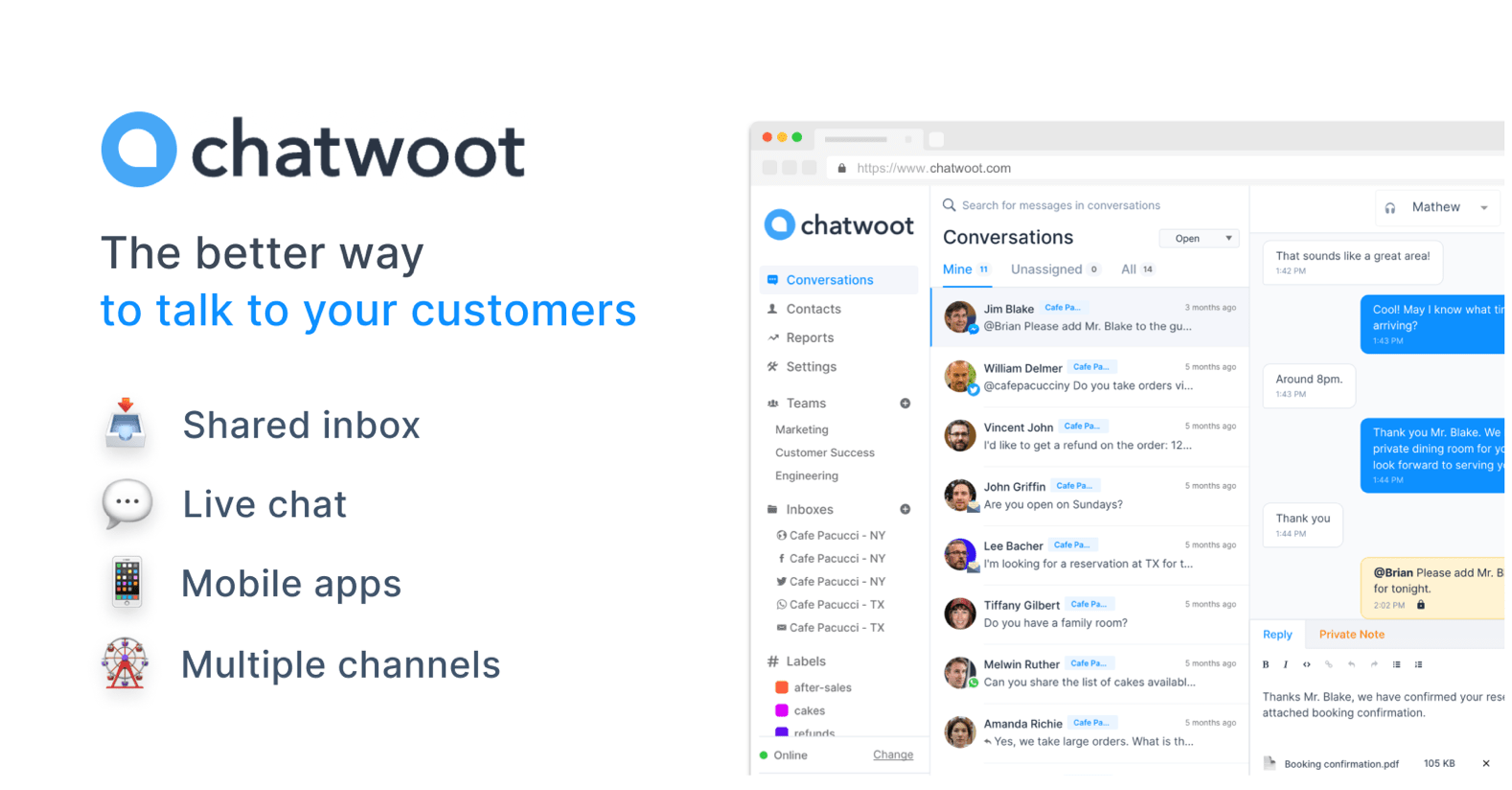
Chatwoot is an open-source, chat-first support platform you can either use on its cloud or run yourself. The cloud Hacker plan is free for two agents and 500 conversations a month and is limited to live chat, while the self-hosted Community Edition is free forever with no agent cap, which is where most small teams end up. Paid cloud plans start at $19 per agent a month, and the wider channels such as voice and the WhatsApp Cloud API are held back for those tiers.
tawk.to
tawk.to is the rare tool that is free with no agent limit at all: unlimited agents, unlimited chat volume and unlimited sites, funded by selling optionally hired chat agents rather than by charging for seats. It is live-chat-first with an omnichannel inbox behind it, so it suits a small business answering website visitors more than one running a formal ticket queue. Add-ons such as removing the tawk.to badge cost $29 a month, and there is no self-hosted option if you need the data on your own hardware.
Odoo Helpdesk
Odoo's One App Free plan is unusual: one app, unlimited users, no charge, which makes Helpdesk free for a whole team so long as Helpdesk is the only Odoo app you use. It pulls email, live chat and WhatsApp into one ticket view and inherits Odoo's automation and reporting. The catch is that boundary, since adding a second Odoo app moves you onto the Standard plan at around US$31 per user a month, so it fits teams that want a ticket desk and nothing else, or that were going to buy Odoo anyway.
osTicket
osTicket is the long-running open-source ticketing system, downloaded and run on your own PHP server, and it funnels email, web forms and API submissions into one queue with departments, ticket filters, SLA plans, canned responses and a customer portal. There is no seat charge because there is no vendor plan at all; the real cost is your server and the time spent keeping it patched. If you would rather not run it, the same team sells the hosted SupportSystem edition from $12 per agent a month.
FreeScout
FreeScout is a lightweight open-source shared inbox, deliberately modelled on Help Scout, that runs on ordinary PHP and MySQL hosting and supports unlimited agents, tickets and mailboxes. Out of the box it centralises email, WhatsApp, Telegram, Facebook, Slack and live chat in one place. The core application is free, but a good deal of what other tools bundle, including tags, time tracking and chat, is sold as separate modules under a lifetime licence per installation, so budget for a handful of them.
Hesk
Hesk is a 21-year-old PHP help desk aimed squarely at small and medium teams: install it on your own hosting and you get a ticket queue, canned responses, auto-assignment and a built-in knowledge base, with no per-agent billing anywhere. The free download carries a Powered by Hesk credit, and a one-time licence removes it without unlocking any extra features, so the free build is functionally the full product. Hesk Cloud exists from $299 a year, priced flat rather than per agent, if you would rather not run a server. It is plain rather than modern, which is much of the appeal.
UVdesk
UVdesk's open-source edition is free forever with no agent limit, installed on your own server, and is built on Symfony with a strong e-commerce slant: it ships integrations aimed at marketplace sellers alongside email, a form builder and social channels. That focus makes it a sensible fit for a small online retailer and an odd one for a services business. UVdesk's own hosted plans start at $8 per agent a month billed annually, with a two-agent minimum.
Zammad
Zammad is a fully open-source help desk under the GPL v3 that ships the complete feature set in its self-hosted build rather than a cut-down community edition, which is why teams wanting a serious ticket system without a subscription keep landing on it. It handles email, web forms, SMS, chat and Telegram, with LDAP integration, ticket templates and fine-grained permissions. Running it is more involved than uploading PHP, since it wants Ruby, Elasticsearch and PostgreSQL, and Zammad's own hosted plans start at EUR 7 per agent a month if you would rather they ran it.
How we researched this
Free had to mean a plan or a download a business can keep using, not a trial. That kept Freshdesk off the page even though it heads most free help desk roundups: its entry tier is now $19 per agent a month after a 14-day trial. LiveAgent, Zendesk, Help Scout, Front and Groove fail the same way. Bitrix24 (free for one or two users, and CRM first) and GLPI (IT asset management first) were judged off target, Faveo Helpdesk's community pages no longer load, and chat widgets like Crisp and Tidio are not help desks.
Paid plans from is written in each vendor's own terms because the bases do not match: per agent, per seat, a flat yearly fee, lifetime modules, or add-ons with no plan at all. osTicket's figure comes from SupportSystem, the hosted edition its team sells on a separate site. Where a cell is empty, the vendor never said: osTicket and Zammad give no seat count for their free builds, Hesk never names its intake channels, and Zoho and HubSpot never state where the free version runs. Free tiers do disappear, as Freshdesk's old Sprout plan did, and the seat and channel limits in this table are the ones posted in September 2026.