Best Open Source CRM for Freelancers
Dolibarr is an open source CRM aimed squarely at freelancers: its own front page names them, and the same PHP install that tracks leads also sends quotes and invoices. If you would rather not run a server at all, Odoo CRM is the only one here with a hosted plan that stays free, for one app with unlimited users.
Most of the nine can hold a sales pipeline, so for a solo business the choice turns on what else the tool does and where it lives. Monica tracks people rather than deals, Dolibarr adds billing, and Twenty and Corteza let you design the data model yourself. SuiteCRM, Dolibarr and Krayin install on ordinary PHP web hosting, while EspoCRM, Twenty, Frappe CRM and Corteza document Docker, which usually means renting a VPS.
Our picks
- No server and no bill: Odoo CRM. Hosted free for one app with unlimited users and no time limit, though adding a second app moves you to the paid per-user tier.
- Cheapest paid hosting: Frappe CRM. $5 a month, billed per site rather than per seat, so bringing in a collaborator costs nothing extra.
- Quotes and invoices in the same tool: Dolibarr. Leads, quotes, invoices, recurring billing and payments in one install that runs on ordinary PHP hosting.
- A network of past clients and referrers: Monica. Built to remember people and follow-ups rather than deals, for a flat $9 a month or $90 a year with no per-contact charge.
- Keeping your code changes private: Krayin. MIT in its repository license file, the only MIT row here, and it installs with a single Composer command on PHP hosting.
At a glance
| Option | License | Built with | Best for | Hosted plan | Cheapest hosted plan | How you self-host it |
|---|---|---|---|---|---|---|
| AGPL-3.0source | PHPsource | Everyday sales pipelinesource | Free trial, then paidsource | $15.00 per user/month (Basic plan)source | Dockersource | |
| AGPL-3.0source | PHPsource | Everyday sales pipelinesource | Free trial, then paidsource | From £50 / month for fully managed hostingsource | PHP web hostingsource | |
| LGPL-3.0source | Pythonsource | All-in-one business suitesource | Free plan, no time limitsource | Free for one app, with unlimited userssource | Linux packagessource | |
| AGPL-3.0source | TypeScriptsource | Building a custom CRMsource | Free trial, then paidsource | $9 per user/month (Pro plan)source | Dockersource | |
| AGPL-3.0source | Pythonsource | Everyday sales pipelinesource | Free trial, then paidsource | $5 per month for unlimited userssource | Dockersource | |
| AGPL-3.0source | PHPsource | Personal relationshipssource | Free trial, then paidsource | $9 USD per month or $90 USD per yearsource | Docker or PHP hostingsource | |
| GPL-3.0source | PHPsource | Invoicing and business adminsource | Free trial, then paidsource | 14€/month/user on DoliCloudsource | PHP web hostingsource | |
| MITsource | PHPsource | Everyday sales pipelinesource | Paid hosting onlysource | Managed hosting priced per server, not per seatsource | PHP web hostingsource | |
| Apache-2.0source | Gosource | Building a custom CRMsource | Dockersource |


Paying for hosted CRM: per user, per site, or flat
The hosted prices are written on different bases, and for one person the basis matters more than the figure. EspoCRM's $15 per user a month looks modest until you meet its three-user minimum on the cheapest tier, which makes self-hosting the cheaper route until you have a team. Twenty charges $9 per user, Dolibarr's DoliCloud 14€ per user, and SuiteCRM's managed hosting starts from £50 a month.
Frappe CRM ($5 a month for unlimited users) and Monica ($9 a month flat) do not charge by the head at all. Krayin prices its managed hosting per server but quotes it through sales, and no current hosted Corteza plan could be found, so plan on running that one yourself.
Shared PHP hosting or a VPS with Docker
Five of the nine are PHP apps, but only SuiteCRM, Dolibarr and Krayin list ordinary web hosting as the install route, and Monica documents both that and Docker. EspoCRM is PHP too, yet it steers you to an official Docker image that sets up the app, NGINX and MySQL together, which is painless if you already rent a server.
Twenty (TypeScript), Frappe CRM (Python) and Corteza (Go) all run in Docker, and Odoo installs from Linux packages. Docker usually means a VPS rather than a basic shared host, so count one into the cost if you pick one of them to run yourself.
License fine print on Krayin, Twenty and Odoo
Krayin's repository says MIT, but Webkul's own cloud hosting page calls it AGPL, so settle that before building something you mean to keep private. Twenty is AGPL-3.0 for most of its code, with some files under a separate commercial license. Odoo CRM's LGPL-3.0 covers the Community edition you install yourself, and the Enterprise-only modules are held back from it.
The license matters most if you plan to modify the code: the AGPL and GPL projects here (EspoCRM, SuiteCRM, Frappe CRM, Monica, Dolibarr and Twenty) ask you to publish changes you distribute, while Krayin's MIT and Corteza's Apache-2.0 let you keep them to yourself.
The options in detail
EspoCRM
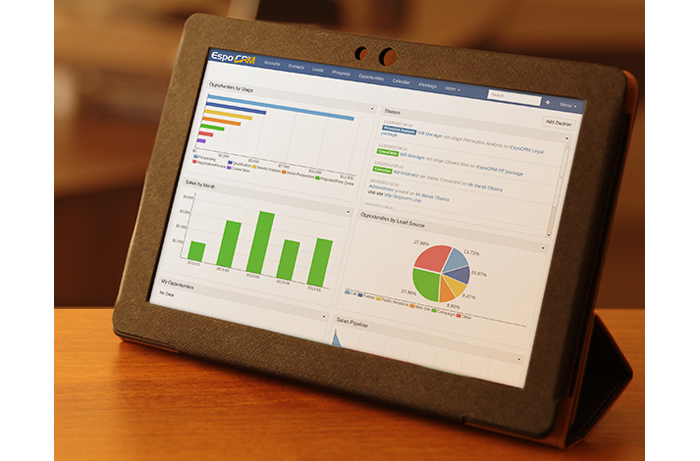
EspoCRM is the most conventional sales CRM on this list: contacts, accounts, deals, support cases with a built-in customer portal, and email campaigns, all in one app rather than a suite. Its admin tools let you add your own entities, fields and workflows without writing code, and the project publishes an official Docker image that sets up the app, NGINX and MySQL together, which makes the self-hosted route unusually painless. The awkward part for a freelancer is the hosted plan: EspoCRM's cloud is billed with a three-user minimum on its cheapest tier, so running it yourself is the cheaper route until you have a team.
SuiteCRM
SuiteCRM is the heavyweight here: a full sales, marketing and service CRM that includes quotations, aimed at people who want something close to a Salesforce-scale feature set without the licence. It runs on standard Apache, PHP and MySQL, so ordinary web hosting can take it, and the makers sell managed hosting and support rather than per-user licences, which means you get the whole platform whichever route you choose. The trade-off for one person is that breadth: a freelancer will use a fraction of its modules and still carry the setup and upkeep of all of them.
Odoo CRM
Odoo's CRM is one app inside a much larger open source business suite, and it is the only tool here whose hosted version is genuinely free with no time limit: one app, unlimited users, on Odoo's own servers. The pipeline is a drag-and-drop kanban and incoming email lands on the record automatically, and if you later want invoicing, accounting or a website they are separate apps in the same system rather than another tool. Two catches: adding a second app moves you onto the paid per-user tier, and the Community edition you self-host is the open source half, with the Enterprise-only modules held back.
Twenty
Twenty is the most modern-feeling CRM here, built for technical people who would rather shape the data model than accept someone else's: custom objects, fields and views from settings, no-code workflows, and code extensions on top for anything further. It self-hosts with Docker Compose and the hosted version is per seat. It is also the option most clearly aimed at teams: a freelancer gets a fast, well-designed CRM, but pays per seat for hosting and takes on a young, fast-moving project if they run it themselves. Note the licence is AGPLv3 for most of the code, with some files under a separate commercial licence.
Frappe CRM
Frappe CRM is a clean, opinionated sales CRM from the team behind ERPNext, and it has the friendliest hosted price on this list: the plan is billed per site rather than per seat, so adding people costs nothing. Custom fields and tables are point-and-click and automation is written as small Python scripts, and it connects to ERPNext if you later want invoicing and accounting. It is a younger product than SuiteCRM or Odoo, so there is less third-party material around it, and self-hosting means running the Frappe stack with Docker rather than dropping files on a web host.
Monica
Monica is a personal CRM rather than a sales one: it is built to remember the people in your life, what they told you and what you meant to follow up on. For a freelancer whose pipeline is really a network of past clients, referrers and contacts, that framing fits better than it first sounds, and the pricing follows it: one flat hosted subscription with no per-contact or per-seat charge, or self-host with Docker or ordinary PHP hosting. What it deliberately does not have is the sales machinery: the project states outright that it is built for relationships, not pipelines, so there are no deals, quotes or invoices.
Dolibarr
Dolibarr is an ERP and CRM in one package, and it names freelancers as an intended audience on its own front page. For a solo business that matters: the same install that tracks leads and contacts also issues quotes and invoices, handles recurring billing, generates the PDFs and records payments, which is usually the second tool a freelancer ends up buying. Modules are switched on and off as you need them, and it runs on ordinary PHP hosting. The interface shows its age next to Twenty or Frappe CRM, and enabling too many modules is the quickest way to make it feel heavy.
Krayin
Krayin is a Laravel CRM from Webkul and the only option here under the permissive MIT licence, which matters if you want to build something on top of it and keep your changes to yourself. It covers the everyday ground of leads, contacts, quotes and activities, and installs with a single Composer command onto the kind of PHP hosting a freelancer is likely to already have. One thing to know before you rely on the licence: Webkul's own cloud hosting page calls the project AGPL, while the repository's LICENSE file and composer.json both say MIT. Their managed hosting is priced per server rather than per user, but the plans are quoted through sales rather than published.
Corteza
Corteza is not really a CRM out of the box: it is a low-code platform written in Go that ships a CRM among the applications you can build and reshape on it. Pick it when the standard CRM shape is wrong for the work you do and you would rather define your own objects, forms and automation, and when you want a licence permissive enough to sell what you build without publishing your changes. The cost is real: everything else on this list gives you a working CRM on day one, and Corteza gives you the toolkit to make one. I could not find a hosted Corteza plan sold by the maintainers today, so plan on running it yourself in Docker.
How we researched this
The shortlist was cut for a person working alone as much as for the license. CiviCRM is built for nonprofits, Mautic describes itself as marketing automation, and OroCRM and Erxes are shaped for larger companies. Vtiger, the biggest omission, ships under the Vtiger Public License, which is not OSI-approved, and Akaunting (Business Source License) and Invoice Ninja (Elastic License) fail the same test, so none of them are on the page. Licenses were settled from each project's license file rather than badges, which is where Krayin's MIT and Odoo's LGPL came from.
Cheapest hosted plan is printed in each maker's own words because the bases differ, so read it rather than sort it. Corteza's two hosting cells are empty: its maintainer now leads with a different product, and no hosted Corteza plan could be found on its pages. EspoCRM's three-user minimum, printed apart from its headline price, is the kind of term a solo buyer only meets in the small print.