Best Payroll Software for Enterprise
For an enterprise already committed to an HR suite, the best payroll is usually that suite's own: Workday Payroll, Oracle Fusion Cloud Payroll and SAP SuccessFactors Employee Central Payroll each reach about 60 countries and earn their place by sharing one set of records with HR and finance. For multi-country payroll without replacing the HR system, the specialists include ADP Global Payroll, at 140+ countries from a company founded in 1949, and Papaya Global at 180+.
The two questions that separate the rest are how many countries a vendor can actually pay people in, and who operates the pay cycle. Six products here are software your own team runs, five add an optional vendor-run service, and two, Papaya Global and CloudPay, run payroll for you end to end.
Our picks
- Widest stated country reach: Dayforce. Over 200 countries and territories, with pay recalculated continuously as time is captured, which makes off-cycle runs and corrections simpler.
- Shift-heavy employers: UKG Pro. Scheduling, time and attendance and payroll follow one set of rules, the workforce management side that came from Kronos in the 2020 merger.
- Handing multi-country payroll to one provider: CloudPay. Its own experts run the payroll across 140+ countries and 110+ currencies, with employee and tax-authority payments handled as part of the service.
- A US-centric employer with a small payroll team: Paychex Flex Enterprise. Once a run is approved, direct deposits, tax filings and pay stubs are handled for you, with custom analytics added at this large-employer tier.
At a glance
| Option | Platform type | Payroll countries | Payroll service model | Ownership | Founded | Headquarters |
|---|---|---|---|---|---|---|
| Global payroll platformsource | 140source | Software plus managed servicesource | Public companysource | 1949source | Roseland, NJsource | |
| Full HCM suitesource | 60source | Software plus managed servicesource | Public companysource | 2005source | Pleasanton, CAsource | |
| Full HCM suitesource | 150source | Software plus managed servicesource | Private companysource | 2020source | Lowell, MA and Weston, FLsource | |
| Full HCM suitesource | 200source | Software plus managed servicesource | Private companysource | 1992source | Minneapolis, MNsource | |
| Full HCM suitesource | 60source | Software you runsource | Public companysource | 1977source | Austin, TXsource | |
| Full HCM suitesource | 60source | Software you runsource | Public companysource | 1972source | Walldorf, Germanysource | |
| Full HCM suitesource | 5source | Software you runsource | Public companysource | 1998source | Oklahoma City, OKsource | |
| Payroll and HR platformsource | 100source | Software you runsource | Public companysource | 1997source | Schaumburg, ILsource | |
| Payroll and HR platformsource | Software you runsource | Private companysource | 2016source | San Francisco, CAsource | ||
| Global payroll platformsource | 150source | Software you runsource | Private companysource | 2019source | Remote (incorporated in Delaware, U.S.)source | |
| Global payroll platformsource | 180source | Fully managed servicesource | 2016source | New York, NYsource | ||
| Payroll and HR outsourcing providersource | 140source | Fully managed servicesource | 1996source | Andover, United Kingdomsource | ||
| Payroll and HR outsourcing providersource | Software plus managed servicesource | Public companysource | 1971source | Rochester, NYsource |






Payroll inside an HR suite or beside it
Six of these are full HCM suites: Workday, UKG Pro, Dayforce, Oracle, SAP and Paycom. For Oracle, SAP and Workday the choice is really a platform decision. Oracle's payroll is most compelling next to Oracle ERP, SAP's is the natural path for companies still on SAP ERP HCM on-premise, and Workday's fits organisations standardising on Workday for HR. Buying any of them for payroll alone means buying into much more.
The global specialists work differently. Papaya Global sits next to an existing HR system and also moves the money, which most vendors leave to your banks. Deel Global Payroll covers employees, contractors and employer-of-record workers in one system, though its EOR, contractor payments and owned-entity payroll are sold as separate products with separate commercials.
Why the country counts are not like for like
Every figure in the Payroll countries column is the vendor's own, and they measure different things. Dayforce's 200+ and Papaya's 180+ include partner-delivered payroll, Oracle's and SAP's 60 are native or localised counts, and ADP's 140 covers payroll, HCM and outsourcing services together. Workday runs payroll itself in a short list of countries and reaches 60+ only with Strada. Paylocity's 100+ is aggregated data through its partner Blue Marble, and UKG's 150+ comes from a page about compliance across countries.
Paycom is the useful reality check. It advertises 190 countries for managing an international workforce, but its native payroll covers five: the US, Canada, Ireland, Mexico and the UK.
Public or private on a multi-year contract
Seven of these vendors are publicly traded, which puts their financials in front of a procurement team: ADP, Workday, Oracle, SAP, Paycom, Paylocity and Paychex. UKG Pro, Rippling and Deel are private, and Dayforce joined them when Thoma Bravo took it private in February 2026. Rippling and Papaya Global date from 2016 and Deel from 2019, and Rippling is the least proven at the top of the enterprise market, though it runs global pay in-house rather than reselling another provider's.
The options in detail
ADP Global Payroll
ADP's multinational payroll product, which brings its GlobalView and Celergo services together so one system of record covers every country a company operates in. ADP states it provides payroll, global HCM and outsourcing services in more than 140 countries, and pitches itself as a single payroll provider handling pay generation, tax calculation and local compliance in each one. Worth being clear about scope: this is not ADP's US-domestic line, so a buyer comparing Workforce Now or Vantage HCM is looking at a different ADP product than the one on this row.
Workday Payroll
Payroll built into Workday's HCM suite, so pay runs read the same records as HR, time and finance instead of syncing between systems. Workday runs payroll itself in a short list of countries and reaches more than 60 in total once Workday Payroll provided by Strada is included, with certified bi-directional integrations to partner payrolls in 180+ more. It fits organisations already standardising on Workday for HR; a company that wants payroll alone is buying into a much larger platform.
UKG Pro
UKG's enterprise HCM suite, pairing HR and payroll with the workforce management heritage that came from the Kronos half of the 2020 merger. It is strongest where scheduling, time and attendance and payroll have to obey one set of rules, which is why it turns up most in healthcare, retail, manufacturing and other shift-heavy employers. UKG Global Payroll consolidates multi-country pay data and compliance across 150+ countries, and UKG sells managed services on top for teams that would rather not run the cycle themselves.
Dayforce
Formerly Ceridian, Dayforce is a single-application HCM suite whose signature is continuous payroll calculation: pay is recalculated as time is captured rather than batched at period end, which makes off-cycle pay, corrections and on-demand pay straightforward. It claims the widest reach in this comparison, over 200 countries and territories, and sells a managed payroll service for companies that want Dayforce staff running the cycle. Thoma Bravo took the company private in February 2026, so its financials are no longer public.
Oracle Fusion Cloud Payroll
Oracle's payroll module, native to Fusion Cloud HCM and most compelling for organisations already running Oracle ERP, because payroll, HR and finance then share one data model and one set of reporting. Oracle processes payroll natively in more than 60 countries and extends further through regional and global partners rather than its own in-country operations. Pricing is quote-based and rollouts are consultant-led, so in practice it is an option for companies with an existing Oracle relationship and the integration capacity to match.
SAP SuccessFactors Employee Central Payroll
SAP's payroll engine delivered as part of SuccessFactors, and the natural destination for the large installed base still running SAP ERP HCM on-premise. Localisation is supported in 60 countries, and SAP has been layering automation on top, including a set of payroll agents introduced in its first half 2026 release. Like Oracle, this is a suite decision more than a payroll decision: the value shows up when core HR, time, benefits and finance sit on the same platform.
Paycom
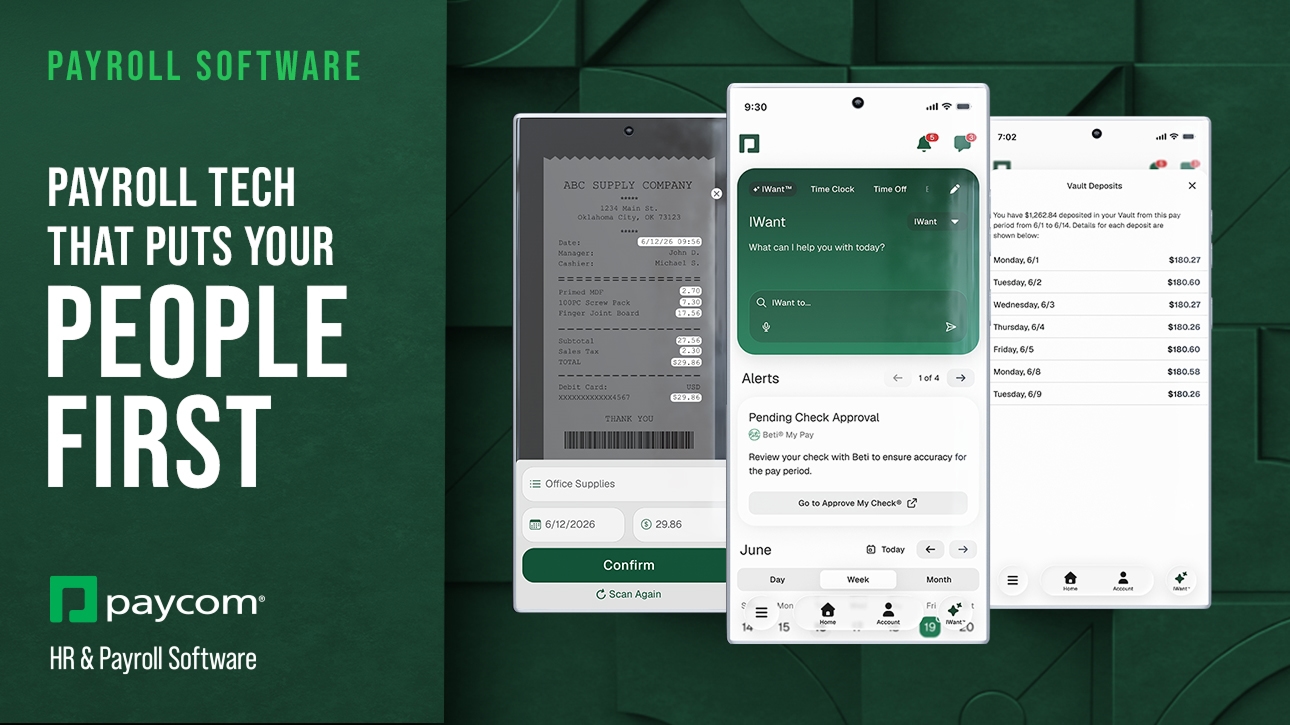
A single-database US HCM suite whose distinguishing idea is Beti, which hands payroll review to employees so they find and fix their own errors before the run is submitted. Everything lives in one database rather than in integrated modules, which is the reason companies pick it when they want one vendor for HR and pay. Its international story is much thinner than the rest of this list: native payroll processing covers Canada, Ireland, Mexico and the UK alongside the US, and the 190-country figure Paycom advertises is about managing an international workforce, not paying it.
Paylocity
A payroll and HR platform that grew up in the mid-market and now sells to large employers, known more for employee experience and internal communication than for global depth. Payroll sits beside expense management, on-demand payment, tax services and managed garnishment handling, and Paylocity is a registered IRS reporting agent in all 50 states, Puerto Rico, the Virgin Islands and Guam. Global payroll is delivered with partner Blue Marble and gives aggregated data across 100+ countries rather than Paylocity running pay in them.
Rippling
Rippling ties payroll to an employee record that also drives IT provisioning, devices, benefits and spend, so one hire or termination updates everything at once. Pay runs happen on your own schedule with no charge for extra runs, and Rippling makes a point of handling global pay in-house rather than reselling someone else's payroll. It is the youngest vendor here and the least proven at the top of the enterprise market, and it publishes no country count for employee payroll, which makes its global coverage harder to compare with the rest of this table.
Deel Global Payroll
Deel started in contractor payments and employer of record hiring, then extended into running payroll in countries where the customer already owns entities, covering employees, contractors and EOR workers across 150+ countries in one system. That breadth is its argument against stitching together a different local provider in every market. Be precise about which Deel you are buying: EOR, contractor payments and owned-entity payroll are separate products with separate commercials, and only the last is payroll software in the sense the rest of this table means.
Papaya Global
A global payroll and payments platform aimed squarely at enterprises, and unusual in combining payroll processing with the money movement itself: most vendors calculate the payroll and leave the payments to your banks. Papaya covers 180+ countries with dedicated payroll, compliance and implementation teams behind each account, and in the US it calculates, files and pays federal, state and local taxes on the client's behalf. It is a payroll specialist rather than an HR suite, so it sits next to an existing HRIS instead of replacing one.
CloudPay
The oldest global payroll specialist in this comparison, tracing its first payroll product to 1996, and the most clearly outsourced of the group: CloudPay's own experts run the payroll and the platform is how the client sees it. It reports 140+ countries serviced and 110+ currencies, with employee and tax-authority payments handled as a managed service alongside the payroll itself. Pick it when the goal is to hand multi-country payroll to one accountable provider rather than to give an internal payroll team better software.
Paychex Flex Enterprise
Paychex is best known for small-business payroll, but Flex Enterprise is its large-employer tier, adding custom analytics, training and deeper compliance support to the same full-service model. Once a run is approved, Paychex handles direct deposits, tax filings and pay stubs, which makes it the low-effort option for a US-centric employer without a large in-house payroll team. International coverage is the weak spot: Paychex publishes no country count for payroll and describes its client base as the US and Europe.
How we researched this
The thirteen products cover each kind of vendor an enterprise payroll shortlist tends to hold: payroll inside an HR suite, payroll-first platforms, global payroll specialists and outsourced providers. Gusto, isolved and Justworks were left out as small and mid-sized business tools, TriNet because a PEO's co-employment model does not compare on these columns, and Remote, Neeyamo, Ramco and Mercans because they mostly appear as partners behind vendors already listed. ADP is represented by ADP Global Payroll, its multinational product, rather than Workforce Now or Vantage HCM.
Product details come from each vendor's own pages, and the company facts (ownership, founding year, headquarters) mostly from Wikipedia, since vendor about pages rarely state a founding year. Eleven of the thirteen publish no price for these products, so cost is left to the RFP. Empty cells mark facts no source stated: Rippling gives no country count for employee payroll (its 185+ is for contractor payments), Paychex describes its reach only as the US and Europe, and neither Papaya Global nor CloudPay states its ownership. Company facts in this market move, from Dayforce's take-private to Oracle's announced move from Austin to Nashville, so re-check them during due diligence.