Cheapest Email Marketing Tools
Updated .
| Option | Starting Price | Contacts at Starting Price | Sends at Starting Price | Free Tier | Free Plan Contacts | Free Plan Sends |
|---|---|---|---|---|---|---|
Zoho Campaigns has the cheapest paid plan in this set at $4 a month for 500 contacts, and that tier lifts sending to unlimited. Its Forever Free plan is roomy too: 2,000 contacts and 6,000 emails a month with five users, where most free plans allow one. The pull is the rest of Zoho, with 35+ app integrations and a natural fit if you already use Zoho CRM or Mail. Automation on the entry plan is deliberately basic (basic segmentation, basic drag-and-drop workflows), with the deeper tooling reserved for higher tiers. | $4source | 500source | Unlimitedsource | Free plansource | 2,000source | 6,000 emails/monthsource |
Brevo prices mainly by emails sent rather than by list size, which makes it the odd one out here: the free plan will store up to 100,000 contacts but sends only 300 emails a day. The cheapest paid plan is $9 a month on monthly billing, covering 5,000 emails and 500 contacts. That shape suits a big list you mail rarely and fits badly with a small list you mail often, where the daily cap bites first. Brevo also bundles SMS, WhatsApp, push, live chat and a sales CRM, so it spans more channels than anything else at this price. | $9source | 500source | 5,000 emails/monthsource | Free plansource | 100,000source | 300 emails/daysource |
Mailjet is priced by email volume: the free plan carries 1,000 contacts and 6,000 emails a month but caps you at 200 emails a day, and $9 a month lifts that to 8,000 emails and 2,000 contacts with no daily limit. It is the pick when you also need a transactional sender, since the API, SMTP relay and webhooks are in the free plan rather than an upsell. Its own logo stays on your emails until the $17 Essential plan, later than most rivals. Unlimited contacts, segmentation and team collaboration live on that same higher tier. | $9source | 2,000source | 8,000 emails/monthsource | Free plansource | 1,000source | 6,000 emails/month (200/day cap)source |
Moosend is one of two tools here with no free plan at all (GetResponse is the other): you get a 30-day trial, then $9 a month for 500 contacts. What that buys is unlimited sending, which makes it the cheapest option for anyone mailing a small list very frequently. Automation workflows, landing pages, subscription forms and an SMTP server are all in the entry plan. Transactional email and SSO sit outside it, and the missing free tier makes Moosend harder to try casually than its rivals. | $9source | 500source | Unlimitedsource | Free trial onlysource | 0source | Nonesource |
EmailOctopus has the most generous free plan of the mainstream tools here: 2,500 subscribers and 10,000 emails a month, in exchange for EmailOctopus branding on your emails and reports that only go back 30 days. Paid is a single Pro tier at $10 a month for 500 subscribers on monthly billing ($9 if you pay yearly), which unlocks design control, permanent reporting, unlimited landing pages and forms, and unlimited users. There is no free trial by design: the company tells you to start on the free plan and upgrade when you outgrow it. It is a deliberately simple product, so anyone needing deep automation branching or ecommerce features will find it thin. | $10source | 500source | 10,000 emails/monthsource | Free plansource | 2,500source | 10,000 emails/monthsource |
Sender's free plan is one of the largest anywhere: 2,500 subscribers and 15,000 emails a month, with automation, landing pages and popups included, in exchange for Sender branding on what you send. Paid starts at $10 a month billed monthly for 1,000 subscribers and 12,000 emails, which removes the branding and adds SMS, A/B testing and role-based seats. The odd part is the shape of the tiers: the entry paid plan allows fewer subscribers than the free one, so upgrading is about features and branding rather than headroom. | $10source | 1,000source | 12,000 emails/monthsource | Free plansource | 2,500source | 15,000 emails/monthsource |
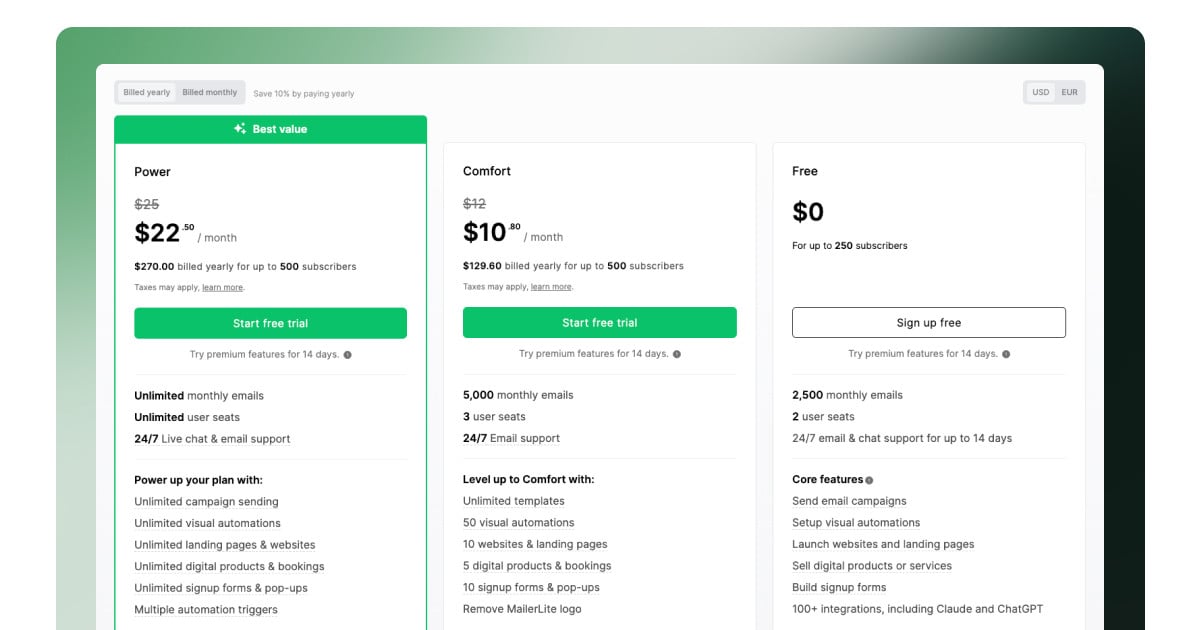
MailerLite pairs a usable free tier with a cheap full-feature paid plan: $12 a month covers 500 subscribers and 5,000 sends, and every paid plan carries the whole toolset rather than gating features by price. The free plan is small at 250 subscribers and 2,500 emails a month, and it keeps the MailerLite logo on your emails until you upgrade. Sending is metered as well as list size, since Comfort gives you ten times your subscriber tier each month, so a heavy sender on a small list can hit the ceiling long before outgrowing the plan. Unlimited sending starts on the $25 Power plan. | $12source | 500source | 5,000 emails/monthsource | Free plansource | 250source | 2,500 emails/monthsource |
SendPulse bundles email with chatbots, SMS, a CRM and even course hosting, and its free tier reflects that: 500 subscribers with 15,000 emails a month, one of the most generous free send allowances here. Standard is $12 a month billed monthly at the same 500-subscriber tier, lifting email to unlimited, removing SendPulse branding and adding A/B testing, scheduling and three users. Pricing scales by list size, so the gap to the cheapest rivals widens as you grow. It suits someone who wants several channels in one inexpensive account more than someone who only wants a newsletter. | $12source | 500source | Unlimitedsource | Free plansource | 500source | 15,000 emails/monthsource |
Mailchimp is the default name in email marketing and the priciest of the true entry plans here: Essentials starts at $13 a month for 500 contacts, with a monthly send limit of ten times your contact count. The free plan has shrunk to 250 contacts and 500 sends a month, so it now works as a demo rather than a place to run a small list. What the money buys is breadth: audience tooling, the full template library, A/B testing, four-step automations and 24/7 email and chat support. The price rises with your contact total, which is exactly why so many of the cheaper tools here sell themselves as Mailchimp alternatives. | $13source | 500source | 10x contact limitsource | Free plansource | 250source | 500 emails/monthsource |
AWeber is one of the oldest names in email marketing and still runs a real free plan: 500 subscribers and 3,000 emails a month. Paid Lite is $15 a month billed monthly (or $12.50 a month if you pay for the year) at the same 500-subscriber tier, with a send ceiling of ten times your list. The Lite tier is deliberately narrow, allowing one email list, three landing pages, three automations and one custom segment before you step up to Plus. Its pitch is creator-friendly extras such as landing pages, digital product sales and 24/7 support rather than the lowest possible price. | $15source | 500source | 10x subscriber maxsource | Free plansource | 500source | 3,000 emails/monthsource |
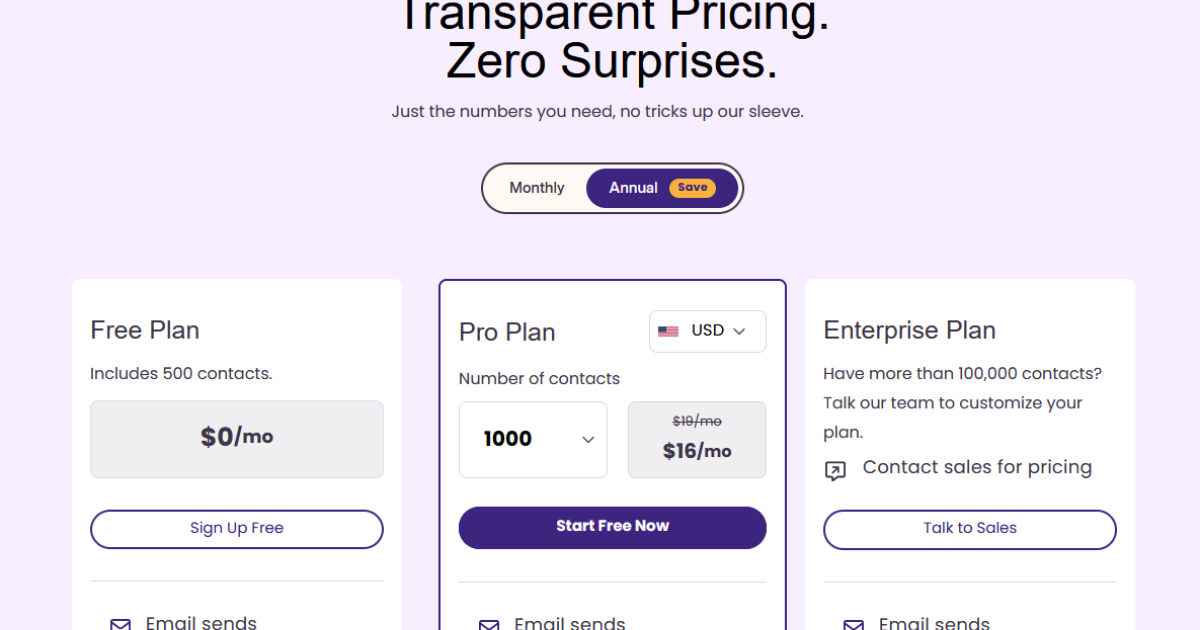
Omnisend is built for ecommerce rather than newsletters: the entry paid plan is $16 a month for 500 contacts and 6,000 emails, and web push is included on every tier, unlimited from Standard up. The free plan is tight at 250 contacts and 500 emails a month, which is enough to wire a store up and test flows but not to run them. SMS sits on the same account, billed per message from $0.007, and the Pro tier adds AI personalization on top. If you are not selling products, you are paying for machinery you will not use. | $16source | 500source | 6,000 emails/monthsource | Free plansource | 250source | 500 emails/monthsource |
Benchmark Email gives free users the full feature set rather than a stripped-down one: 500 contacts, with sending capped at five times your contact limit and a hard ceiling of 2,500 emails a month. Paid starts at $19 a month and the smallest paid tier is 1,000 contacts, so it skips the 500-contact price point most rivals sell, and paid sending rises to ten times your contact limit. Every plan includes exactly one user and extra seats cost $15 a month each, which makes it expensive for a team. It is a reasonable pick for a solo sender who wants everything unlocked on day one. | $19source | 1,000source | 10x contact limitsource | Free plansource | 500source | 2,500 emails/monthsource |
GetResponse has the most expensive entry plan here at $19 a month for 1,000 contacts, and no free plan, only a 14-day trial of premium features. What the price covers is unlimited monthly sends on every tier plus a landing page builder, signup forms and popups, and one custom automation workflow on Starter. Its real distinctiveness sits further up the range: webinars, a website builder and course creation on the Creator plan. As a pure cheap-email pick it is hard to argue for; as an all-in-one marketing platform it is one of the broadest in this list. | $19source | 1,000source | Unlimitedsource | Free trial onlysource | 0source | Nonesource |
Kit (formerly ConvertKit) has the largest free plan in this list by an order of magnitude: up to 10,000 subscribers with unlimited broadcasts, unlimited landing pages and forms, and audience tagging. The trade is what paid costs when you need it, at $39 a month billed monthly for 1,000 subscribers, which buys visual automations, email sequences, A/B testing, SMS and removal of Kit branding. It is built around creators and newsletters rather than shops or sales teams, with digital product and subscription selling included even on the free tier. For a large list that only sends broadcasts, that free plan is unusually hard to outgrow. | $39source | 1,000source | Unlimitedsource | Free plansource | 10,000source | Unlimitedsource |