self hosted cloud storage
Updated .
| Option | Type | License | Cost to self-host | Mobile apps | GitHub stars |
|---|---|---|---|---|---|
Nextcloud is the default answer for people who want a whole Google Workspace replacement on their own hardware rather than just a file drive: the server ships with files, calendar, contacts, chat and video calls, and Nextcloud Office adds real-time document editing through Collabora or Euro-Office. It runs on an ordinary PHP and database stack, which makes it easy to put on cheap hosting but heavier than the Go-based alternatives once you have a lot of files. Desktop and mobile clients are first-party and cover Windows, macOS, Linux, Android and iOS. The same server is also sold as Nextcloud Enterprise, where the money buys support, SLAs and enterprise add-ons rather than the software itself. | Collaboration suitesource | AGPL-3.0source | Free core, paid editionssource | Official iOS and Android appssource | 36,700source |
Infinite Scale is ownCloud's ground-up rewrite: a cloud-native Go service that replaces the old PHP application and ships as a single binary or container, scaling from a Raspberry Pi to a Kubernetes cluster. It concentrates on fast, auditable file sync and share with enterprise access controls instead of trying to be a whole workspace, and it is built to sit on top of several storage backends at once behind one access layer. ownCloud publishes first-party desktop and mobile apps, and the Community edition is free while the Standard and Enterprise subscriptions add support and a commercial licence. Worth knowing that the older PHP product, ownCloud 10, is still sold and maintained alongside it, so make sure documentation you find refers to the version you are running. | File sync and sharesource | Apache-2.0source | Free core, paid editionssource | Official iOS and Android appssource | 2,100source |
OpenCloud is a young fork of the Infinite Scale codebase run by a Berlin team with a long open-source track record, aimed squarely at European organisations that want digital sovereignty rather than another US cloud. It is Apache-2.0 and the Community Edition can be self-hosted free of charge, with per-user Basic, Professional and Premium plans above it that add production and long-term-support releases, password policies and Kubernetes support. It has moved fast for its age and already ships desktop clients plus iOS and Android apps, and it deliberately runs without a traditional relational database. The obvious gap is Microsoft: the vendor states there are currently no Microsoft 365 integrations, which matters if your team lives in Office. | File sync and sharesource | Apache-2.0source | Free core, paid editionssource | Official iOS and Android appssource | 5,900source |
Seafile is what people reach for when raw sync speed and very large file counts matter more than breadth of features. Instead of keeping your files as ordinary files on the server's disk it uses its own block-based storage engine, which is what makes it quick with millions of files but also means you cannot just browse the data on the server with a file manager. The Community Edition server is released under the Affero GPLv3 and is free to run; a Professional Edition is priced per user per year, is free for up to three users, and adds things like S3 storage, high availability and Office integration. First-party clients cover desktop, Android and iOS, and recent versions have added custom file properties and multiple views on top of plain sync. | File sync and sharesource | AGPL-3.0source | Free core, paid editionssource | Official iOS and Android appssource | 15,200source |
Syncthing is the odd one out here because there is no server at all: it keeps folders identical across your own devices over a direct encrypted connection, so nothing is ever stored on a machine you do not control and there is nothing to administer or pay for. That design removes whole categories of problem, and creates others: there is a browser-based interface, but it is for configuring sync rather than browsing your files like a cloud drive, there are no public share links, and if all your devices are lost there is no central copy left. It is MPLv2, entirely free, and by a wide margin the most starred general-purpose tool in this comparison. Best thought of as continuous backup and sync between machines you own, not as a Dropbox replacement. | Peer-to-peer syncsource | MPL-2.0source | Free, open sourcesource | 88,300source | |
Pydio Cells is the Go rewrite of the old PHP Pydio, built around workspaces, fine-grained permissions and audit trails rather than consumer convenience. It suits organisations that have to prove who accessed what, and it connects to Collabora and ONLYOFFICE for document editing in the browser. Cells Home is free for home use and evaluation, with paid Connect and Enterprise distributions above it, and there are official iOS and Android apps. Its GitHub following is small next to Nextcloud's, so expect vendor documentation rather than a large community to be your source of help. | Collaboration suitesource | AGPL-3.0source | Free core, paid editionssource | Official iOS and Android appssource | 2,200source |
Immich is not a general file drive: it is a self-hosted replacement for Google Photos, with background upload from your phone, face and object recognition, albums, sharing and a scrolling timeline. It is by far the most starred project in this list and moves very quickly, and the maintainers state plainly that every feature will stay free with nothing put behind a paywall. The mobile apps are first-party and available on both the App Store and Google Play, which is the whole point of the project. It expects real hardware, the quick-start asks for at least 6GB of RAM and two CPU cores, and the README itself tells you to keep a 3-2-1 backup of your photos rather than trusting any single server. | Photo and video librarysource | AGPL-3.0source | Free, open sourcesource | Official iOS and Android appssource | 113,300source |
File Browser is the smallest useful thing in this comparison: one binary that puts a web interface in front of a directory you already have, with upload, preview, in-browser editing, share links and user accounts. There is no sync client, no mobile app and no database to run, which is exactly the appeal if all you want is browser access to a folder on a home server or a NAS. It is Apache-2.0 with no paid edition, and its star count is high for how deliberately small it is. If you want phone photo backup, calendars or document collaboration, this is the wrong tool. | Web file managersource | Apache-2.0source | Free, open sourcesource | 36,000source | |
Filestash stores nothing itself: it is a web front end that connects to storage you already run, including S3, SFTP, FTP, SMB, NFS, WebDAV, Git, Dropbox and Google Drive. That makes it a neat way to give people a browser interface over a NAS or an object store without migrating a single file, and a poor fit if you wanted the software to own your storage. The self-hosted AGPLv3 build is free for up to three users, with company and enterprise plans starting at $50 and $290 a month that add SSO, RBAC and support. It also offers an On Demand Sync client that installs on Windows, macOS, Linux, Android and iPhone. | Web file managersource | AGPL-3.0source | Free core, paid editionssource | Official iOS and Android appssource | 14,600source |
MinIO is object storage rather than a file drive: an S3-compatible server that applications, backup tools and other self-hosted apps point at, not something you browse like Dropbox. It is the usual way to get an S3 endpoint of your own at home or in a lab, and the Community Edition is AGPLv3 and free of charge for a full-featured single-node deployment. Above that sit the commercial AIStor subscriptions, which is where the company's development attention goes, so check what the Community Edition covers before you build on it. There is no mobile app and no user-facing sharing story, by design. | Object storagesource | AGPL-3.0source | Free core, paid editionssource | 61,400source | |
SeaweedFS is a distributed store designed for very large numbers of small files, promising a single disk seek per read and horizontal scaling; on top of that it offers an S3 API, POSIX-style mounts and, more recently, Iceberg tables for analytics. It is Apache-2.0, free, and funded largely by sponsorship, with a separate Enterprise Edition sold for data recovery, self-healing storage and erasure-coding repair. This is infrastructure rather than a consumer cloud, so plan on running something else in front of it for the user interface. Choose it over MinIO mainly when file count and scaling behaviour are the constraint. | Object storagesource | Apache-2.0source | Free core, paid editionssource | 34,400source | |
SFTPGo is a file transfer server rather than a cloud drive: it speaks SFTP, FTPS, HTTP/S and WebDAV, and it can put any of those protocols in front of local disk, S3, Google Cloud Storage or Azure Blob. That makes it the right answer when you need to hand people or systems a standard protocol endpoint without moving the data behind it, and the wrong one if you wanted a photo timeline or shared documents. The Open Source Community edition is AGPLv3 and described by its own vendor as fully functional and production-ready; commercial Starter and Premium editions are sold as subscriptions or lifetime licences and add cloud storage streaming, automation and compliance controls. There is no vendor mobile app, but standard SFTP and WebDAV clients connect to it. | File transfer serversource | AGPL-3.0source | Free core, paid editionssource | 12,500source | |
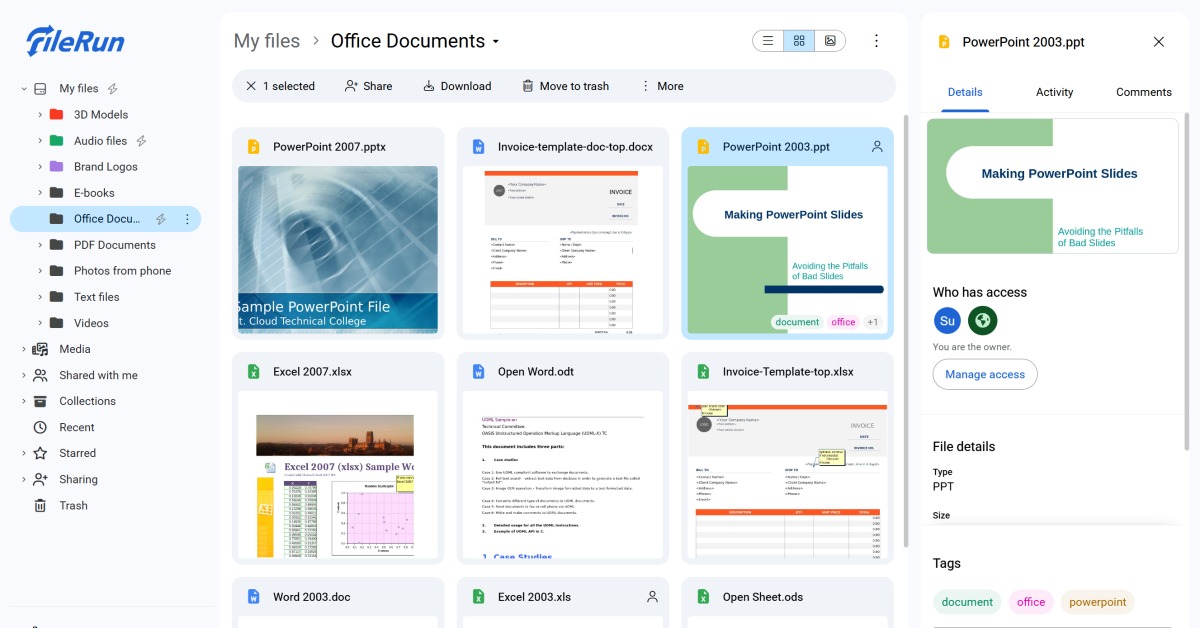
FileRun is the commercial option in this list: a PHP application you install on your own server that presents the folders already sitting on its disk, with no import or migration step. It sells itself as a straight Google Drive replacement for a team, with iOS and Android apps, WebDAV access, desktop two-way sync and automatic phone photo upload, and the company says it has been doing this since 2003. The licence is €9.9 per user per year and is registered against your server's domain name rather than being a subscription to somebody else's storage. Being closed source, there is no public repository to inspect and no community to fall back on, which is the trade you are making for a supported product. | File sync and sharesource | Proprietarysource | Paid license onlysource | Official iOS and Android appssource | |
Peergos takes the privacy question further than anything else here: files are end-to-end encrypted with post-quantum cryptography before they leave your machine, and the project states that even the metadata about who you shared a file with stays private. It is a peer-to-peer network as well as a storage app, so a node you host yourself can still share with people running on other nodes. Self-hosting is free and the code is AGPLv3; the project charges only for space on its own servers, and says openly that it has no free tier there so its interests stay aligned with paying users. It is far smaller and younger than the mainstream options and the feature set is correspondingly narrow, so treat it as a privacy-first alternative rather than a Dropbox replacement. | Peer-to-peer syncsource | AGPL-3.0source | Free, open sourcesource | Official Android app onlysource | 2,500source |



.png)