Cherry Blossom and Spring Bloom Viewing Near West Des Moines
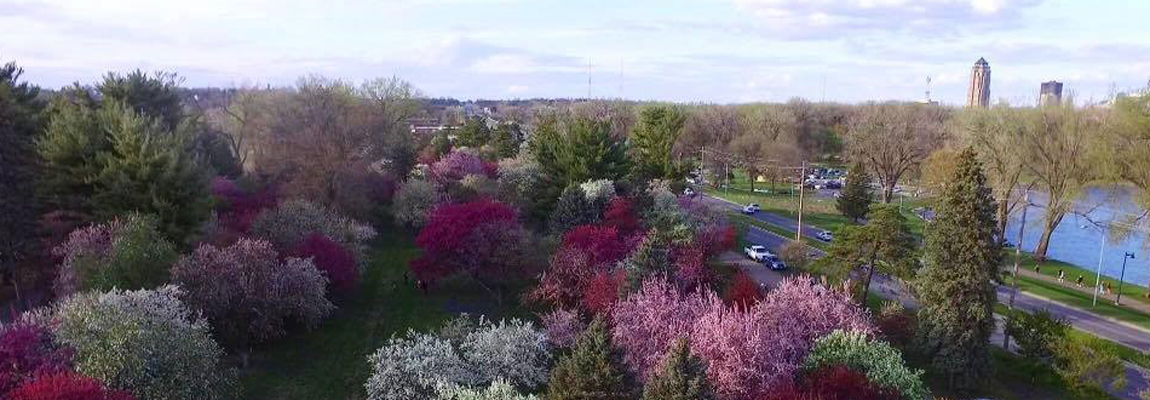
Only one place near West Des Moines has cherry trees a local source will vouch for: the tree-lined pond in Greenwood Park, down the hill behind the Des Moines Art Center. The spring tree show around Des Moines is mostly crabapple, and the biggest of it is the Arie den Boer Arboretum inside 1,500-acre Water Works Park, which usually blooms from the last week of April into the first week of May.
The twelve sites split two ways. The public grounds (Water Works, Ewing Park's lilacs, the Capitol's crabapples) bloom on the trees' own schedule, and Ewing's lilacs last about two weeks. Reiman Gardens in Ames and Wilson's Orchard & Farm in Cumming plant tulips for spring, which makes them the safer bet for a fixed weekend, at $12 and $5 for an adult.
Our picks
- Actual cherry blossoms: Greenwood Park. The only row whose signature bloom is cherry, around a pond in the city's oldest park, with a rose garden up the hill that peaks later, in May and June.
- The biggest mass of flowering trees: Arie den Boer Arboretum at Water Works Park. One of the world's largest flowering crabapple collections, where the grounds crew still grafts new trees from the founder's original varieties; open 6:00 am to 10:00 pm.
- Cutting a bouquet to take home: Wilson's Orchard & Farm – Des Moines. $5 to walk the tulip field or $20 to cut your own with shears and a jar included, and $3 or $18 if you buy online ahead.
- A stroller walk: Gray's Lake Park. A flat, paved 1.9-mile loop with tulips and daffodils along the water, and a tunnel under Fleur Drive to the crabapples next door.
- Kids who won't last through a garden walk: Iowa Arboretum & Gardens. A woodland treehouse playscape built for all abilities, $12 for adults and $7 for ages 3 to 12, closing at 4 pm.
At a glance
| Option | Admission | Address | City | Signature Blooms | Site Type | Grounds Size | Hours |
|---|---|---|---|---|---|---|---|
| 2201 George Flagg Parkway, Des Moines, IA 50321source | Des Moinessource | Crabapplesource | City parksource | 1,500source | 6:00 am to 10:00 pmsource | ||
| Freesource | 25141 260th Street, Dallas Center, IA 50063source | Dallas Centersource | Crabapplesource | Arboretumsource | 143source | Open daily 8am to sunsetsource | |
| $14source | 909 Robert D. Ray Dr, Des Moines, IA 50309source | Des Moinessource | Tulipssource | Botanical gardensource | 12source | Tue–Fri 10 am–5 pm, Sat–Sun 9 am–4 pm, closed Mondayssource | |
| $12source | 1875 Peach Ave, Madrid, IA 50156source | Madridsource | Mixed flowering treessource | Arboretumsource | 170source | Weekdays 9 am–4 pm, weekends 10 am–4 pmsource | |
| 5300 Indianola Ave, Des Moines, IA 50315source | Des Moinessource | Lilacsource | City parksource | 35source | Open daily 6:00 a.m. to 10:00 p.m.source | ||
| 100 45th St, Des Moines, IA 50312source | Des Moinessource | Cherrysource | City parksource | 80.8source | |||
| 2101 Fleur Dr, Des Moines, IA 50321source | Des Moinessource | Tulipssource | City parksource | 166.6source | |||
| Freesource | 705 N Buxton St, Indianola, IA 50125source | Indianolasource | Mixed flowering treessource | Arboretumsource | 5.4source | ||
| $5source | 3201 15th Ave, Cumming, IA 50061source | Cummingsource | Tulipssource | Orchardsource | 125source | Spring hours Wed–Sun 10am–6pm, closed Mon–Tuesource | |
| Freesource | 100 Locust Street, Des Moines, IA 50309source | Des Moinessource | Mixed flowering treessource | Public gardensource | |||
| Freesource | 1007 E Grand Ave, Des Moines, IA 50319source | Des Moinessource | Crabapplesource | Historic groundssource | 17source | Building Mon–Fri 8:00 a.m.–4:45 p.m., Sat 8:00 a.m.–3:45 p.m.source | |
| $12source | 1407 University Blvd, Ames, IA 50011source | Amessource | Tulipssource | Botanical gardensource | 17source | Open daily 9 a.m.–5 p.m.source |



Cherry, crabapple, lilac or tulip
The Signature Blooms column is the honest answer to the page's title. Greenwood Park is the lone cherry row, and its trees are not labeled or signed. Crabapple carries three rows (Water Works, The Brenton Arboretum, the Iowa State Capitol Grounds), tulips carry four (the Botanical Garden, Gray's Lake, Wilson's, Reiman), and Ewing Park Lilac Arboretum is the only lilac hillside, with more than 1,000 shrubs.
Two rows look like crabapple destinations and are not quite. Brenton has a crabapple collection with its own map, but its signature collection is the Kentucky coffeetree, which does not blossom, so its spring color is scattered across 143 acres. At the Capitol, the crabapples ring the east side around the World War II memorial while the west lawn runs daffodils, then tulips, then alliums into May.
Two-week windows versus planted April displays
The trees and shrubs set their own dates. Water Works' crabapples and Ewing's lilacs both tend to peak at the end of April into early May, and Ewing's window runs about two weeks, with the overlook parking filling fast at peak. Gray's Lake's tulips and daffodils open before the trees do, and the Fleur Drive tunnel makes it an easy pairing with Water Works.
Planted bulbs are the predictable option. Reiman Gardens puts in more than 50,000 tulips for an April display with extended hours, and Wilson's farms a tulip field, which also makes it the most crowded spot here on a fine weekend. The Greater Des Moines Botanical Garden sits between the two: a tulip bed outside the entrance you can see without a ticket, and a conservatory that stays tropical year-round for a cold April day.
Admission and closing times
Four sites state a price of zero: Brenton (open 8am to sunset, five dollars per dog), Buxton Park Arboretum in Indianola, the World Food Prize Hall of Laureates Gardens, and the Capitol Grounds. The ticketed end runs $5 at Wilson's, $12 at both Reiman and the Iowa Arboretum & Gardens, and $14 at the Botanical Garden, the highest on the list.
Watch the afternoons. The Iowa Arboretum closes at 4 pm every day, the Botanical Garden closes at 4 pm on weekends and stays shut on Mondays, and Wilson's spring hours skip Mondays and Tuesdays. Water Works and Ewing Park stay open until 10:00 pm, late enough for a visit after work.
The options in detail
Arie den Boer Arboretum at Water Works Park
The closest thing central Iowa has to a cherry blossom festival, and the reason most Des Moines spring photos look the way they do. Water Works Park holds one of the world's largest flowering crabapple collections, started by Dutch horticulturist Arie den Boer in the 1920s and named for him in the 1960s; the utility's grounds crew still grafts new trees from his original varieties. Bloom is short, usually the last week of April into the first week of May, and it draws crowds, picnickers and photographers to the drive along Fleur Drive. It is a working park rather than a manicured garden, so expect open lawns, trails and traffic near the amphitheater rather than paths and benches.
The Brenton Arboretum
A 143-acre arboretum on former Brenton family farmland north of Waukee, planted from scratch starting in 1996 and now holding about 2,500 trees and shrubs representing more than 500 species and cultivars, including a crabapple collection with its own downloadable map. Every tree is tagged with its botanical name, so it is a good place to work out what you are looking at. It is free for people and five dollars per dog, open 8am to sunset daily, which makes it the easiest early-morning walk on this list. The trade-off: its signature collection is the Kentucky coffeetree rather than anything that blossoms, so the spring show is scattered across the grounds instead of massed in one grove.
Greater Des Moines Botanical Garden
The riverfront dome downtown, with 12 acres of outdoor gardens around it that change week by week through spring, plus a tulip display outside the main entrance you can see without buying a ticket. It is the one place here that is worth a visit on a cold or rainy April day, because the conservatory is tropical year-round and there is an indoor natural play area for kids. Admission is $14 for adults, the highest on this list, and it is closed Mondays. Come for a designed garden rather than a mass bloom: the flowering-tree spectacle is at Water Works Park, a ten-minute drive away.
Iowa Arboretum & Gardens
The state's flagship tree collection, founded by the Iowa State Horticultural Society in 1968 and now 170 acres outside Madrid, about 35 minutes north of West Des Moines. Spring here is spread out rather than massed: planted tree groves, formal gardens, and native woodland and prairie trails, with things opening in sequence from April into June. The Adele and Dean Bowden Treehouse Village, a woodland playscape built for all abilities, makes it the strongest pick here if you are bringing children who will not last through a garden walk. Admission is $12 for adults and $7 for children ages 3 to 12, and it closes at 4pm, so plan a half day rather than a late-afternoon stop.
Ewing Park Lilac Arboretum
Thirty-five acres of lilacs on a hillside in the city's largest park, set aside in 1939 and opened to the public in 1947, now more than 1,000 shrubs across 250-plus varieties. This is the one bloom on the list you smell before you see it, and the window is famously short: about two weeks, typically at the end of April into early May. Harry Piper Parkway runs through the arboretum so you can drive the loop, but the overlook and parking fill up fast at peak and the city warns about crowds. The rest of Ewing Park is disc golf, mountain-bike trails, a dog park and a playground, so it is easy to combine with something else.
Greenwood Park
If you came looking specifically for cherry blossoms, this is the spot local parents name: the tree-lined pond in Greenwood Park, down the hill behind the Des Moines Art Center. It is the city's oldest park, bought from a private owner who had already cleared roads and dammed a creek to make the lake, and the first to open to the public, in 1894, so the trees are mature and the setting is a designed nineteenth-century landscape. The Clare and Miles Mills Rose Garden sits at the top of the hill and peaks later, in May and June, so one walk can catch two seasons. The cherries are not a labeled collection and nothing is signed, so treat this as a walk rather than a destination display.
Gray's Lake Park
The city's most visited park, and the natural other half of a crabapple trip: a pedestrian tunnel under Fleur Drive connects it directly to the Arie den Boer Arboretum, and the beds along the lake are planted with tulips and daffodils that open before the trees do. The loop trail around the lake is 1.9 miles, flat and paved, with the Kruidenier Trail bridge over the water and the downtown skyline behind it, which is why it is the easiest walk here with a stroller. There is a beach, a playground, a sprayground and boat rentals in season. It is scenery rather than a bloom collection, so come for the combination with Water Works Park rather than for the flowers alone.
Buxton Park Arboretum
Indianola's first park, donated by the Buxton family in 1906 and now a compact 5.4-acre arboretum in the middle of town next to Simpson College. More than sixty species of trees and plants are labeled, with a self-guided tour brochure in the case by the gazebo, so it is the best place near Des Moines to actually learn which flowering tree you are looking at. Formal flowerbeds, a butterfly garden, an ornamental fountain and a children's garden with a play tunnel fill the rest of it. Being small is the point and the limitation: you can see all of it in half an hour, and there is no single mass display, just a lot of different things opening at once.
Wilson's Orchard & Farm – Des Moines
A 125-acre orchard and farm about fifteen minutes southwest of West Des Moines that plants a tulip field for spring: $5 at the gate to walk in, $20 if you want to cut your own bouquet, with shears and a jar included. Buying online ahead is cheaper ($3 and $18). It is the only place on this list where the bloom is farmed rather than landscaped, which makes it the most predictable and also the most crowded on a fine weekend. Children are welcome in the field as long as they stay on the paths. Spring hours are Wednesday to Sunday, 10am to 6pm, and it is closed Mondays and Tuesdays.
World Food Prize Hall of Laureates Gardens
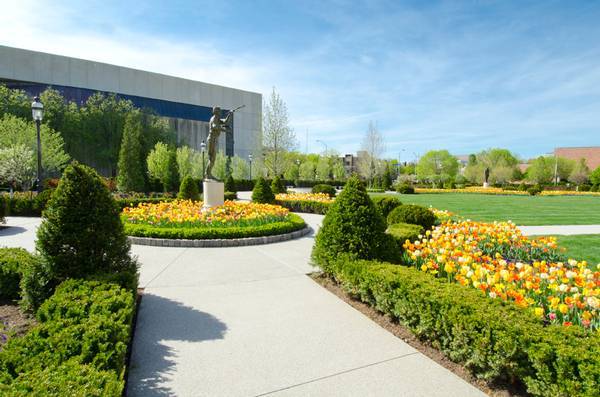
A small formal garden on the Principal Riverwalk downtown, created on what had been a parking lot beside the restored library building that now houses the World Food Prize. In spring it runs flowering pear and crabapple trees with hawthorns, lilacs and magnolias, plus beds of tulips around the sculptures of Norman Borlaug and John Ruan, which is why local photographers book portraits here. It is free and open to walk through, so it fits into a downtown errand rather than filling an afternoon. Tours of the Hall of Laureates itself are also free, but only at set times on Tuesdays.
Iowa State Capitol Grounds
Seventeen acres of state grounds on a hill above downtown, and an underrated spring walk. The west lawn runs daffodils, then tulips, then alliums into May, with the skyline behind them; the east side, around the World War II memorial and its steel Freedom Flame, is ringed with flowering crabapples. Nothing is ticketed and the grounds are open air, so you can visit at any hour, though the building itself keeps office hours and tours are free but scheduled. Parking is on the surrounding streets, which is easy on a weekend and harder when the legislature is in session.
Reiman Gardens
The furthest site here, on the south edge of the Iowa State campus in Ames, and the one that turns spring into a scheduled event: more than 50,000 tulips planted for an April display, with extended hours and a fairy-door scavenger hunt for kids through the 17-acre grounds. Because the bulbs are planted and dated rather than left to nature, this is the most predictable April bloom within an hour of West Des Moines. There is also a year-round indoor butterfly wing, which is the reason to keep it on the list for a cold weekend. Admission is $12 for adults and $6 for children, and the drive is about forty minutes, so it is a day out rather than an afternoon stop.
How we researched this
Central Iowa's spring trees are mostly crabapple and lilac, and the search for cherry plantings turned up one credible local reference, so we built the list around any place within about 40 minutes of West Des Moines that a source ties to a spring bloom, and let the Signature Blooms column say which. Reiman Gardens in Ames is the far edge at about 40 miles, kept for its dated tulip display. Left off: the Polk County Master Gardener gardens in Urbandale and Altoona, which publish no hours, price or acreage; Pella Tulip Time, about 50 miles out and a dated festival rather than a place; Thomas Mitchell Park, whose spring show is native wildflowers; the rose garden inside Greenwood Park, which would have been the same pin twice; and Salisbury House, Jester Park, Walnut Woods and Raccoon River Park, which no source ties to a spring bloom.
An empty Admission cell on the four Des Moines city parks is there because no page puts a price, or the word free, in a sentence about them. Hours for Greenwood and Gray's Lake sit in municipal code we could not read, Buxton's page lists none, and the Capitol's hours are the building's, not the open-air lawns'. Water Works' 1,500 acres is the whole park rather than the crabapple grove. We left out a peak-bloom column because site-specific windows exist for only about half the rows; the ones that are published appear in each summary, and they describe a typical spring rather than a forecast for the next one.