Best free note-taking apps for freelancers
Updated .
| Option | Free Plan Limit | Free Plan Sync | Where Notes Live | Note Format | Paid Upgrade |
|---|---|---|---|---|---|
Notion is an all-in-one workspace where notes, tasks and databases are built out of the same drag-and-drop blocks, which is why freelancers often end up using it as a client tracker as much as a notebook. The free personal plan is generous enough to run a solo practice on, and it syncs across the browser, Mac and Windows apps. The trade-off is that everything lives in Notion's own block format rather than as files you can open elsewhere, and the editor is more machinery than a plain notebook needs when you only want to write a paragraph. | Unlimited devicessource | Cloud onlysource | Blocks and databasessource | $10 per member / month (Plus)source | |
Obsidian keeps every note as a plain Markdown file in a folder on your own computer, so your work stays readable with or without the app. Personal use is free without limits and does not even ask you to make an account, which makes it the safest long-term home for client research you expect to keep for years. Sync between devices is a paid add-on, so on the free plan you are either working on one machine or arranging your own file syncing through something like a shared folder. | No limits on personal usesource | No free syncsource | Local files with optional syncsource | Markdownsource | $4 / month for Obsidian Sync, billed annuallysource |
Evernote is the veteran of the category, with a mature web clipper, document scanning and the strongest search here. Its free plan has been cut back hard, though: 50 notes, one notebook and a single connected device, which is enough to try the app but not to run a freelance business on. Anyone who wants it on both a laptop and a phone is looking at the Starter plan, so treat the free tier as an evaluation rather than a home. | 50 notes, 1 notebook, 1 GB monthly uploadssource | Limited devicessource | Cloud onlysource | Rich textsource | $8.25 / month (Starter, billed annually)source |
OneNote gives you a free-form page you can type, draw or paste anywhere on, organised into notebooks, sections and tabs that mirror a paper binder. It is free to download on every platform and keeps notebooks in OneDrive, so it is the easy pick if you already have a Microsoft account. The loose canvas is wonderful for messy thinking and awkward when you want a tidy linear document, and the free storage you get is really your OneDrive allowance rather than a OneNote one. | Notebooks use your OneDrive storagesource | Unlimited devicessource | Cloud onlysource | Rich textsource | |
Google Keep is the fastest way to get a thought out of your head: coloured cards, checklists, photos and voice memos, synced to everything signed in to your Google account. There are no plans, no limits to think about and nothing to set up. It is deliberately shallow, organising by colour and label rather than folders and offering little formatting, so it works best as the scratchpad beside a heavier app rather than as the place your client work lives. | Unlimited devicessource | Cloud onlysource | Sticky notessource | ||
Apple Notes is already on every Mac, iPhone and iPad, syncs through iCloud with no setup at all, and has quietly grown into a capable editor with tables, checklists, a document scanner and locked notes. For a freelancer working entirely on Apple hardware it is the least-effort option here and costs nothing. The catch is the obvious one: it stops at the edge of Apple's own devices, so it is the wrong choice if a client is going to hand you a Windows machine. | Unlimited devicessource | Cloud onlysource | Rich textsource | None; the app is freesource | |
Joplin is an open-source notebook that keeps your notes on your own machine in an open format and then synchronises them through a service you choose, whether that is Joplin Cloud, Dropbox or OneDrive. That makes it the free way to get cross-device sync without handing your notes to a company, and its end-to-end encryption covers the synced copies. It is less polished than the commercial apps and you have to set the sync target up yourself, which is a real evening's work the first time. | None; the app is open source and freesource | Bring your own cloudsource | Local files with optional syncsource | Markdownsource | 2.99 EUR / month for Joplin Cloud Basicsource |
Standard Notes is built around encryption first, and the free tier is unusually serious about it: end-to-end encrypted, unlimited device sync across web, desktop and mobile, plus offline access, at no cost. What you give up for free is formatting, because plain text is the free editor and Markdown, rich text and code snippets sit behind the Productivity plan. It suits a freelancer whose notes carry client material they would rather nobody, including the maker, could read. | Plain text notes only; formatting is paidsource | Unlimited devicessource | Cloud onlysource | Plain textsource | $90 / year (Productivity)source |
Simplenote does one thing: fast, uncluttered notes with Markdown support, synced instantly to every device, and all of it is free with no paid tier at all. There are no attachments, no folders and no formatting beyond Markdown and tags, which is the entire point. If a heavier app has ever made you wait while you were trying to write one sentence down, this is the antidote, and it runs on iOS, Android, Mac, Windows, Linux and the browser. | None; apps, backups, syncing and sharing are all freesource | Unlimited devicessource | Cloud onlysource | Markdownsource | None; there is no paid plansource |
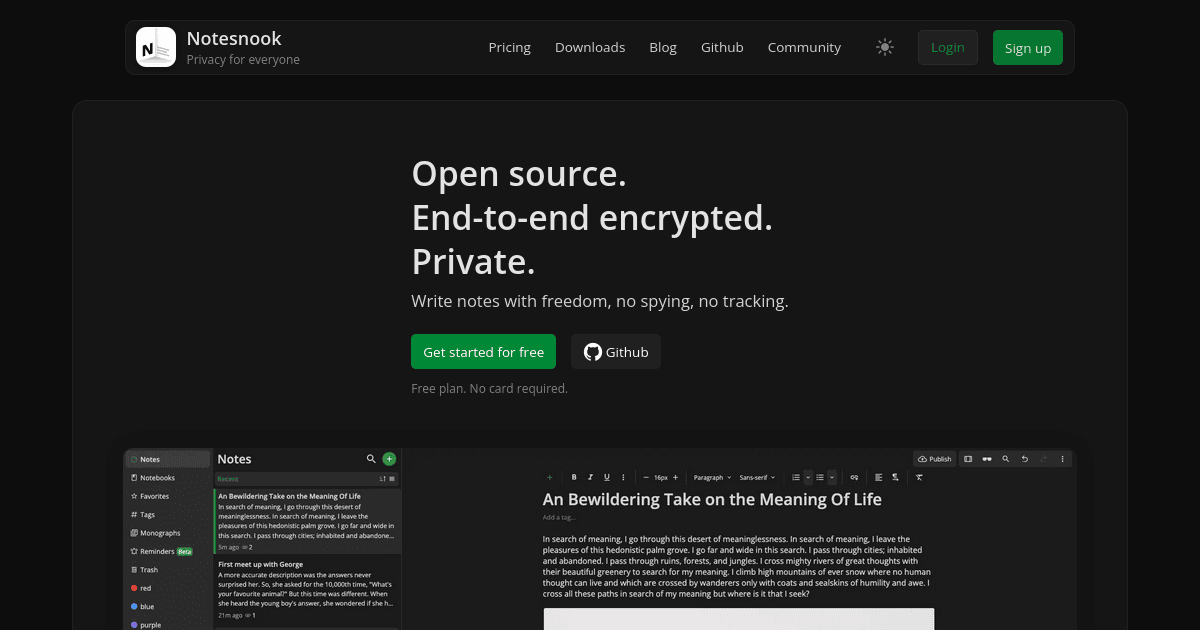
Notesnook is an end-to-end encrypted notebook with a genuinely good editor behind the encryption: tables, checklists, code, maths and outlines rather than a bare text box. Its free plan is unusually honest, giving unlimited notes on unlimited devices with 50MB of attachment storage a month, so the wall you eventually hit is file uploads rather than note count. The paid tiers mostly buy more storage and larger file sizes, which makes it cheap to outgrow gracefully. | Unlimited notes; 50MB/mo storage, 50 notebookssource | Unlimited devicessource | Cloud onlysource | Rich textsource | $1.67 / month (Essential, billed annually)source |
Zoho Notebook organises everything as cards: a sticky note, a sketch, an audio clip or a scanned document, each its own card inside a notebook. The free plan includes 2GB of cloud storage with automatic sync and no ads, which is a lot to get for nothing, and notes can be locked individually. It is the least-known name on this list and makes most sense if you already live in other Zoho tools, but the card metaphor stands on its own for people who think in fragments. | 2 GB of free cloud storagesource | Unlimited devicessource | Cloud onlysource | Sticky notessource | |
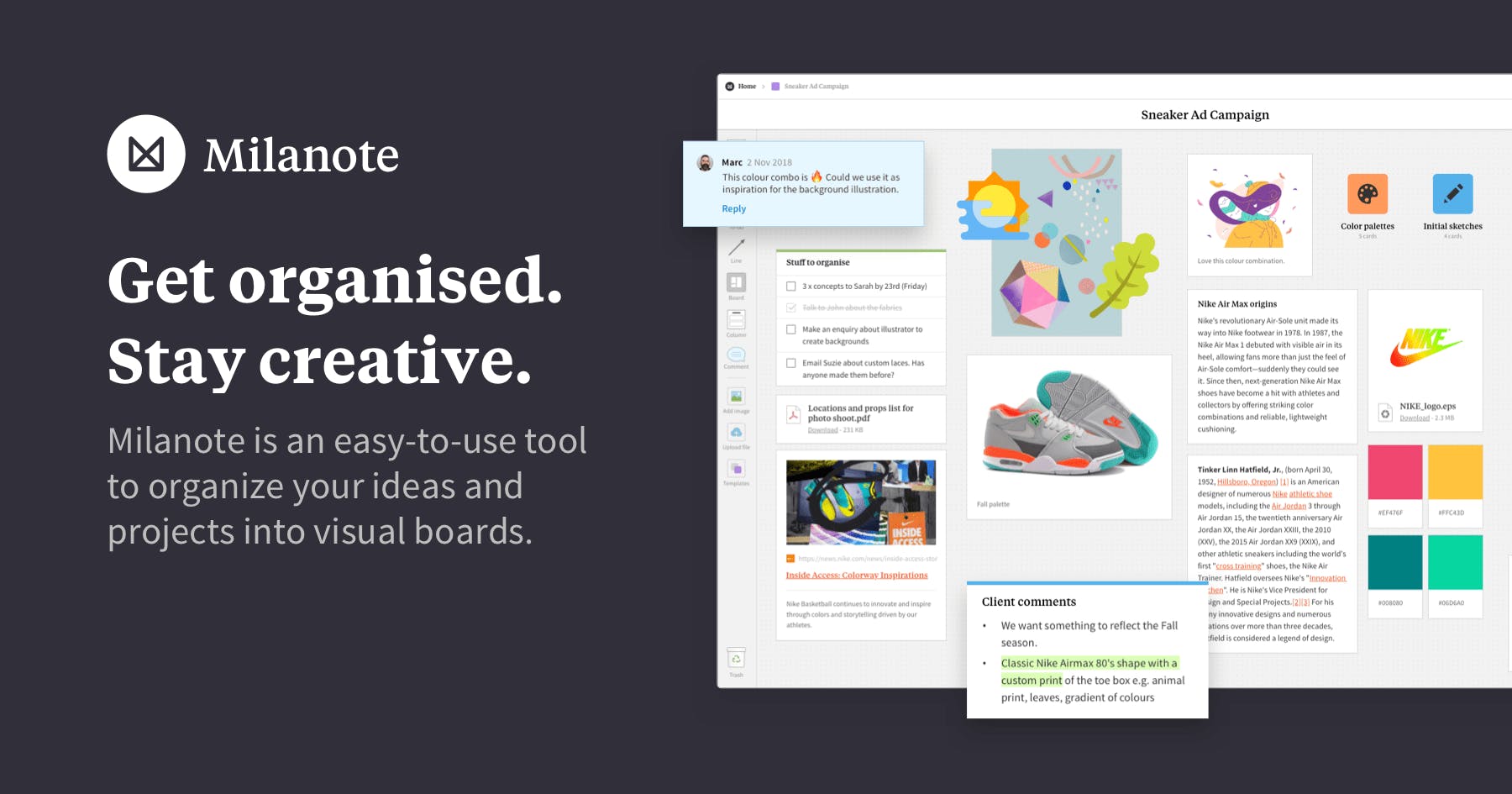
Milanote is a visual board rather than a notebook: notes, images, links and sketches arranged on a canvas, which is why it turns up in the hands of designers, writers, photographers and other creative freelancers building moodboards or outlining a project. The free plan has no time limit but caps you at 100 notes, images or links and 10 file uploads, so it is a real working tool rather than a trial. If you think in long documents and lists rather than in space, it is the wrong shape for you. | 100 notes, images or links; 10 file uploadssource | Unlimited devicessource | Cloud onlysource | Visual boardsource | $9.99 / month billed annuallysource |