Best Learning Management Systems
Fifteen learning management systems compared on who they train, how to try them, billing and starting price, from Moodle and Canvas to TalentLMS and Thinkific. Read our take
At a glance
| Option | Who it trains | How to try it | Billing | Starting price |
|---|---|---|---|---|
| Schools, Colleges, Employeessource | Free plansource | Freesource | Free for individual teachers (Canvas Lite); institutions license through salessource | |
| Schools, Colleges, Employeessource | Free to usesource | Freesource | Free and open sourcesource | |
| Schools, Colleges, Employeessource | Demo firstsource | Not publishedsource | Not published; pricing through salessource | |
| Schools, Colleges, Employeessource | Demo firstsource | Not publishedsource | Not published; pricing through a demosource | |
| Schools, Collegessource | Free to usesource | Freesource | Free for eligible schoolssource | |
| Employees, Partners, Customerssource | Free plansource | Flat monthly feesource | $119 a month billed yearly (Core plan, up to 40 users)source | |
| Employees, Customers, Partnerssource | Demo firstsource | Not publishedsource | Not published; quote on requestsource | |
| Employees, Customers, Partnerssource | Free trialsource | Not publishedsource | Not published; quoted by number of learnerssource | |
| Employees, Customerssource | Demo firstsource | Not publishedsource | Not publishedsource | |
| Employeessource | Free trialsource | Per user per monthsource | $6.91 per user a month (Business plan, 100 users, $8,286 a year)source | |
| Employees, Customers, Partnerssource | Free trialsource | Per user per monthsource | $8 per user a month (Team plan, up to 100 users)source | |
| Employees, Partners, Customerssource | Demo firstsource | Annual contractsource | From $8K a yearsource | |
| Course buyerssource | Free trialsource | Flat monthly feesource | $82 a month billed annually ($109 billed monthly)source | |
| Course buyerssource | Free trialsource | Flat monthly feesource | $44 a month billed annually, plus $5 per paid enrollment (Starter plan)source | |
| Employees, Partners, Customerssource | Demo firstsource | Not publishedsource | Not published; priced by package through salessource |




Our take
The right learning management system depends first on who you are teaching. For a school or university, Moodle is free and open source and Canvas LMS now gives individual teachers a free Canvas Lite account. For training a company's own staff on a budget, TalentLMS has a free plan for up to 5 users and 10 courses and paid plans from $119 a month billed yearly. For selling courses online, Thinkific starts at $82 a month billed annually.
The real split in this table is between platforms you can open today and platforms you meet through a salesperson. Moodle, Google Classroom, Canvas Lite and TalentLMS cost nothing to start, and Absorb LMS, iSpring LMS, 360Learning, Thinkific and LearnWorlds offer free trials. Blackboard, D2L Brightspace, Docebo, LearnUpon, Litmos and Cornerstone start with a demo, and only Litmos prints a figure at all: from $8K a year.
Our picks
- Best free option for schools: Moodle. Free and open source, and used in schools, universities and workplaces.
- Best for a small company starting out: TalentLMS. A free plan for up to 5 users and 10 courses, then $119 a month billed yearly.
- Lowest published per-user price: iSpring LMS. $6.91 per user a month on the 100-user Business plan, or $8,286 a year, with a free trial.
- Best for selling courses: Thinkific. Built to create and sell courses, from $82 a month billed annually with a free trial.
- Best for large enterprise programs: Docebo. Trains employees, customers and partners in one system, with pricing quoted through sales.
School platforms versus workplace training platforms
Five of these are built around classes and students: Canvas LMS, Moodle, Blackboard, D2L Brightspace and Google Classroom. All but Google Classroom also sell into workplace training, but their roots show in gradebooks and terms. Google Classroom is the narrowest, free for eligible K-12 schools and colleges but not meant for employee training.
The business platforms split again by audience. TalentLMS, Docebo, Absorb LMS, Litmos, 360Learning and Cornerstone each describe training employees, customers and partners, LearnUpon runs employee and customer portals side by side, and iSpring LMS is aimed at a company's own staff. Thinkific and LearnWorlds are for people who sell courses to the public.
Per-user, flat-fee or annual contract pricing
The published prices are not on one basis, so compare the wording rather than the number. iSpring LMS charges $6.91 per user a month on a 100-user plan, which works out to $8,286 a year, and 360Learning charges $8 per user a month. TalentLMS and Thinkific charge a flat monthly fee for a band of users or for the account, and Litmos starts at $8K a year on contract.
LearnWorlds starts at $44 a month billed annually, but its entry plan adds a second cost: a $5 fee per paid course enrollment, which its higher plans drop. If you expect steady course sales, the cheapest LearnWorlds plan stops being the cheapest one quickly.
What to check before you sign
A free product still has costs. Moodle has no licence fee, but somebody has to host, update and secure it, which is why many organisations pay a partner or MoodleCloud instead. Canvas Lite is for one educator's courses, so a school still licenses Canvas LMS through sales. LearnUpon's employee plans start at 100 users, so a 20-person team may end up paying for seats it does not use.
The options in detail
Canvas LMS
Instructure's platform and the default choice across much of US higher education, with K-12 and workplace versions alongside it. Its code is openly licensed, which is unusual for a commercial LMS, and reviewers single out the gradebook and SpeedGrader. Schools and companies license it through sales, but an individual teacher, tutor or homeschooling parent can now open a free Canvas Lite account to run a course without an institution.
Moodle
The open-source standard, first released in 2002 and still developed by the Australian company Moodle HQ with a network of partner firms. Anyone can download and run it with no licence fee, and its plugin library is the largest of any platform here, which is why it turns up in schools, universities and company training alike. The catch is that somebody has to own hosting, upgrades and security, so many organisations pay a Moodle partner or use the paid MoodleCloud service instead of running it themselves.
Blackboard
One of the oldest names in the category, first released in 1997 and now run by Blackboard T&L after several years inside Anthology. It is sold mainly to universities, but Blackboard also lists government, workforce and K-12 customers, and it offers add-ons such as a course catalog and the Ally accessibility tool. Pricing goes through a sales conversation, and the platform has lost some large university contracts to Canvas and Brightspace in recent years.
D2L Brightspace
A cloud learning platform from D2L, the publicly traded Canadian company founded in 1999, with separate offerings for K-12, higher education and business training. Its pitch is analytics and reporting across a whole institution, plus a Course Merchant store for selling courses. It is one of the three platforms universities most often shortlist against Canvas and Blackboard, and like them it is priced through a sales demo.
Google Classroom
Google's free assignment hub for schools, bundled with Google Workspace for Education and tied closely into Docs, Drive and Meet. Eligible K-12 schools and colleges pay nothing for the base edition, which is the main reason it spread so quickly. It is lighter than a full LMS, built for creating, handing out and grading assignments rather than running company training or selling courses, and some advanced features sit in the paid Education Plus edition.
TalentLMS
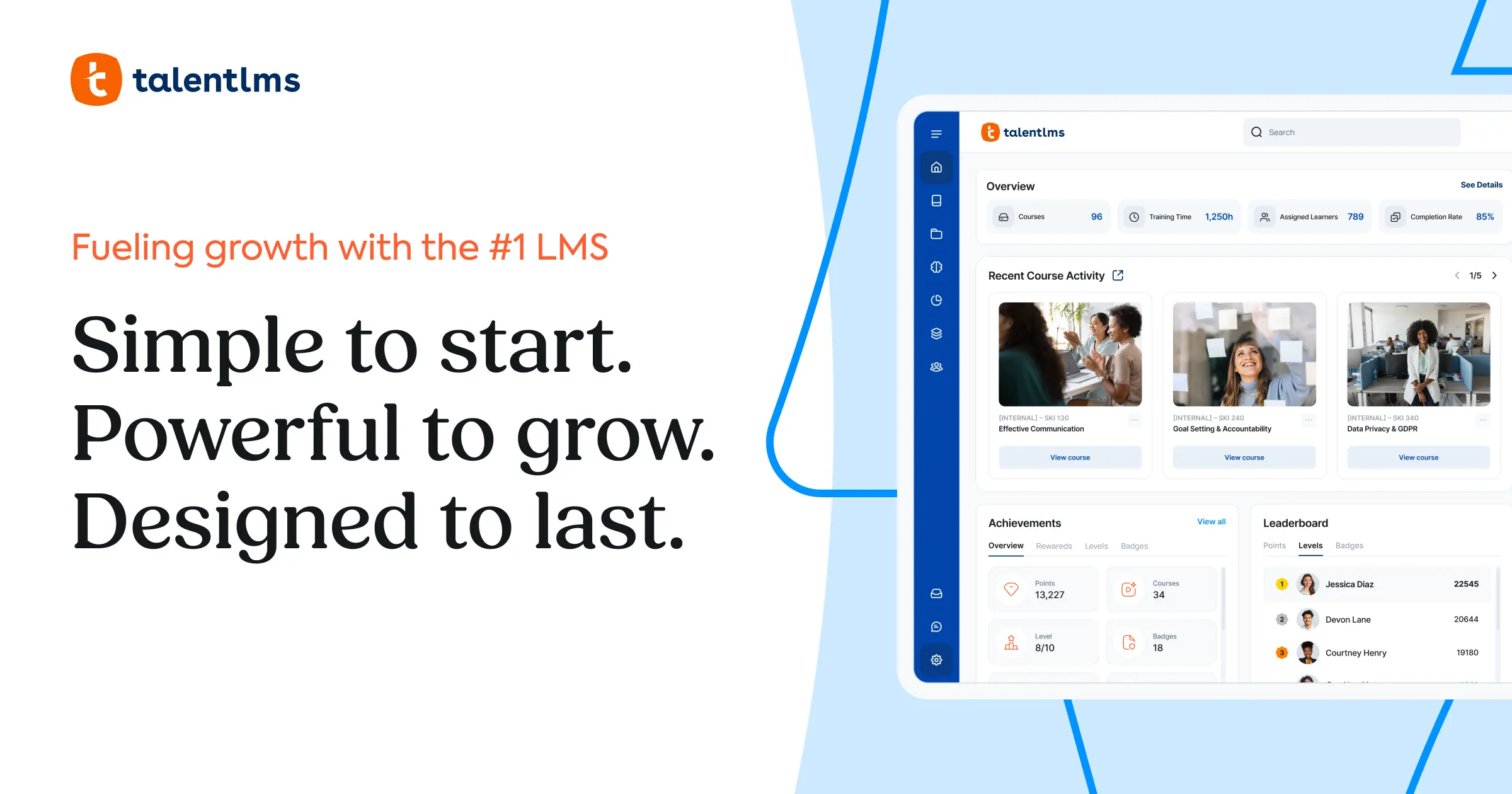
A business training platform from Epignosis aimed at small and mid-sized companies that want to launch quickly without an implementation project. It is one of the few here with a free plan you can keep using, capped at 5 users and 10 courses, and its paid plans are priced by user band rather than per seat. Separate branches let one account run training portals for staff, partners and customers.
Docebo
An enterprise learning platform from a Toronto company listed on the TSX and Nasdaq, built for large organisations training staff, customers and partners from one system. Its strengths are automation, reporting and a long list of add-ons, including an ecommerce module for selling training and extended-enterprise portals. Prices are not published and access starts with a demo, so it suits a company with a formal buying process more than a small team.
Absorb LMS
A corporate LMS from Absorb Software, used for onboarding, compliance training and customer and partner education. It includes its own ecommerce store for selling courses, which Absorb says takes no commission. Prices are quoted by learner count rather than listed, but unlike most enterprise platforms here it offers a free trial before you talk to sales.
LearnUpon
A Dublin-based platform founded in 2012 that runs employee, customer and association training side by side through separate branded portals. It sells plans by audience rather than one price list, and its employee plan starts at 100 users, so it is aimed at mid-sized organisations rather than very small teams. Ecommerce and white labelling come on the Enterprise plan.
iSpring LMS
A corporate training platform from iSpring, which also makes the iSpring Suite course-authoring tool, so the two are designed to work together. It is aimed at employee onboarding and consistent training across locations, and its price is published per user, which is rare among the business platforms here. A free trial is available before buying.
360Learning
A platform built around collaborative learning, where subject experts inside a company create courses and the training team checks them, rather than a central team writing everything. Its roots are employee onboarding and upskilling, but its pricing page pitches one plan for everything from workforce training to customer education and partner enablement. It publishes a single per-user price for small and mid-sized teams and lets you try it for 30 days first, with an enterprise tier above that.
Litmos
A corporate LMS built for training a workforce, partners and customers from one platform, with use cases from employee onboarding to compliance and channel enablement. Litmos is one of the few enterprise vendors that prints a starting price, though it is an annual figure for a contract and the next step is still a pricing request. Access starts with a demo rather than a trial, so it suits a company ready for a sales process.
Thinkific
A course platform that started with its co-founder selling an LSAT prep course, and it is still aimed at people and businesses who sell courses and communities online. Payments, checkout and sales tools are built in from the first paid plan, and it now also markets customer training. It is the wrong fit for a school or for internal compliance training, but one of the simplest ways to put a paid course online.
LearnWorlds
A course platform for running a branded online school, with its own commerce engine for selling courses, bundles and memberships, plus plans for corporate and customer training. The entry Starter plan adds a $5 fee per paid enrollment, which the higher plans drop, so the cheapest plan is not always the cheapest once sales pick up. A 30-day trial gives access to the core features.
Cornerstone
The learning platform from Cornerstone OnDemand, a Santa Monica company founded in 1999 as an online corporate training provider and taken private by Clearlake Capital in 2021. It is one of the long-standing enterprise names in workplace training, sold as part of a wider talent suite that also covers performance, succession and skills, with a separate Extended Enterprise package for selling training to customers and partners. Prices come through sales by package rather than per seat on a public page, so it fits a large organisation buying an HR platform more than a small team that wants to start today.
How we researched this
We read each maker's own product, pricing and trial pages, plus Wikipedia for the open-source and school platforms and one independent pricing guide for LearnWorlds, and recorded each value with the sentence it came from. The set mixes the platforms schools most often shortlist with the business and course-selling platforms that recur across current roundups. Left out: Schoology, Seesaw and other school-only tools covered in our separate comparison for schools, Adobe Learning Manager and WorkRamp, whose prices are sales-only and add little beside Docebo and Cornerstone, and Kajabi and Teachable, which are course storefronts more than learning systems.
Where a maker publishes no price, the table says Not published rather than guessing. The LearnWorlds price comes from that guide because its own pricing page draws the currency symbol as decoration rather than text. Prices and trials change often, so confirm the current offer on the maker's page before you buy.